MigrantWatcher Nimesh Ved recently visited Nagaland and attempted to find out more about the mass hunting of Amur Falcons. For an update on this trip please visit Nimesh’s blog.
See related MW blog post here.

MigrantWatch archive (2007–2015)
Report migrant sightings on eBird India · about this archive

MigrantWatcher Nimesh Ved recently visited Nagaland and attempted to find out more about the mass hunting of Amur Falcons. For an update on this trip please visit Nimesh’s blog.
See related MW blog post here.
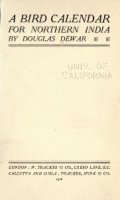
Some extracts from Douglas Dewar’s A Bird Calendar for Northern India, published in 1916. Have you heard the a-onk of a Brahminy Duck (Ruddy Shelduck), or a Coppersmith say wow, or the honking of geese overhead in the night?
|
From the crowded jhil emanate the sweet twittering of the wagtails, the clanging call of the geese, the sibilant note of the whistling teal, the curious a-onk of the brahminy ducks, the mewing of the jacanas and the quacking of many kinds of ducks. … The green barbets also call spasmodically throughout the month, chiefly in the early morning and the late afternoon, but the only note uttered by the coppersmith is a soft wow. The hoopoe emits occasionally a spasmodic uk-uk-uk. The migrating birds continue to pour into India during the earlier part of November. The geese are the last to arrive, they begin to come before the close of October, and, from the second week of November onwards, V-shaped flocks of these fine birds may be seen or heard overhead at any hour of the day or night. The nesting activities of the fowls of the air are at their lowest ebb in November. Some thirty species are known to rear up young in the present month as opposed to five hundred in May. In the United Provinces the only nest which the ornithologist can be sure of finding is that of the white-backed vulture. The nesting season of the tawny eagle or wokab (Aquila vindhiana) begins in November. … The man who attempts to take the eggs or young of this eagle must be prepared to ward off the attack of the female, who, as is usual among birds of prey, is larger, bolder and more powerful than the male. At Lahore the writer saw a tawny eagle stoop at a man who had climbed a tree and secured the eagle’s eggs. She seized his turban and flew off with it, having inflicted a scratch on his head. For the recovery of his turban the egg-lifter had to thank a pair of kites that attacked the eagle and caused her to drop that article while defending herself from their onslaught. |
Taken, with grateful thanks, from Project Gutenberg.
By Mousumi Ghosh
Read Part I in this series of articles on leaf warblers
Wintering Season
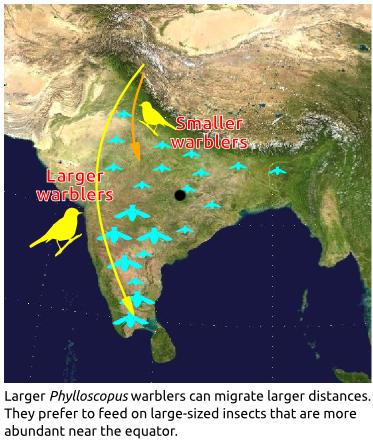 To most of us, Phylloscopus leaf warblers belong to just one size category: tiny! And confusing. Every winter, these diminutive and inconspicuous birds envelope the subcontinent in a wave, migrating thousands of kilometres south from their breeding grounds in the Himalayas and beyond. Migrating long distances takes a lot of energy, particularly for smaller species. Small differences in body weights among species make a huge difference in deciding how far they have to travel for wintering. Small-sized warblers are geared to feed on small insects, which are available in good quantities right from the Himalayan foothills all the way down south. The larger Phylloscopus warblers (like Large-billed, Greenish, and Western-crowned) do not have it so easy, as their preferred food – large insects – are available in adequate supply only further south. Hence, in the wintering season smaller species don’t travel very far, with their southern limit being either the sub-Himalayan foothills (e.g. Lemon-rumped Warbler) or mostly up to Central India (e.g. Hume’s Warbler), where wintering ranges of larger species begin. In contrast, larger species (e.g. Greenish and Western Crowned Warblers) travel farther south and all way to southern India and Sri Lanka.
 A great deal of knowledge about the wintering ecology of Greenish Warblers has emerged from Madhusudan Katti’s work in the Kalakkad-Mundanthurai forests of Tamil Nadu. He found that individual birds, quite remarkably, come back to the same wintering territory year after year! Also, in years of scanty rainfall and limited food the birds were unable to eat enough to moult in time for their long journey back to their breeding sites. This shows how conditions in their wintering habitats may influence whether birds are able to make it back to breed; and this has obvious implications for the size of the population.
Several parallels exist between the way these birds breed and winter. For example, the species which breed on “top of the mountains” (Hume’s and Greenish Warblers) spend the winter on “top of the trees”. Interestingly, while these two species are territorial in winter (both males and females defend territories), others, like the Western-crowned and Lemon-rumped Warblers, join mixed-species flocks. Although most species spend their breeding and wintering seasons in drastically different forests, they use similar foraging techniques. For instance, the Lemon-rumped Warbler (which breeds in conifer-mixed forests and winters in sal forests), mostly captures prey by hovering in the outer foliage of trees in both seasons.
Breeding Season
The Himalayas, because they provide such a huge variety of habitats, harbour one of the richest communities of leaf warbler species in the world. Twenty-one out of the world’s 61 species of Phylloscopus are found in the Himalayan region. They occupy the entire range of habitats from tropical evergreen/deciduous forests in the foothills to the alpine meadows above the treeline. In the Himalayas the elevation zone 2500–3000 m supports the highest diversity of breeding warblers, where up to 9 species may breed together.
How do so many similar species coexist in one place? One reason is that while superficially leaf warblers are very similar, different species possess differently sized body parts. This is associated with differences in foraging behaviour. For instance, larger species eat larger insects and species with wider beaks catch more flying insects. Another way to allow coexistence is by occupying different elevation zones. To avoid competing for similar food using similar methods, each altitudinal zone in the mountain typically has one large species, a medium species and a small species, which capitalize on prey in accordance to their body sizes.
 The overall drab colours of leaf warblers conceal subtle differences which not only indicate the habitat that they breed in, but also help in communicating and selecting mates. To the trained eye, visually distinguishing most of the leaf warblers involves relying on presence, number and colour of brighter patches such as wing bars, supercilium, rump patch and crown stripes. Species occurring in dense habitats, such as the Lemon-rumped Warbler, typically possess many bright patches (two wing bars, a distinct supercilium, crown stripe and rump patch). Such warblers often flash these patches to communicate. Additionally, males with brighter and longer wing bars are of higher quality (such males occupy larger territories) and are preferred by females. On the other hand, the Tickell’s Warbler, which breeds in open Juniper scrub, has no bright patches at all.
To be continued…Coming up next in this series: Tips for Identification of Phylloscopus Warblers
By Mousumi Ghosh
When I started birding seriously in the year 2005 after joining the Master’s course at the Wildlife Institute of India, I 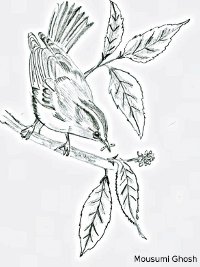 conveniently ignored every warbler I saw. Since visual identification was very difficult (given their frustratingly similar and drab appearances), I was happy enough to say that so-and-so bird was of a warblerish persuasion, and leave it at that. But then, as fate would have it, I wound up studying the wintering ecology of three species of leaf warblers in the Himalayan foothill forests of Himachal Pradesh for my MSc dissertation. While my primary motivation was to understand how they survive the winter sharing dwindling food resources, I now had to identify them accurately for my work to make any sense.
In most situations a bird in hand is worth two in the bush, but when it comes to identifying leaf warblers it is better to have a bird singing in the bushes than have even ten in your hand! This wisdom came to me from my supervisors Mr. Pratap Singh and Dr. Dhananjai Mohan, who taught me how to identify leaf warblers in the field from their calls and song.
These remarkable little birds belong to the family Phylloscopidae, whose members are dressed in various hues of dull green, yellow, grey and occasionally bright chestnut (as in the Chestnut-crowned Warbler). They are among the commonest species of European and Asian forests. The word Phylloscopus literally means ‘looking into the leaves’ and this aptly describes our industrious friends, who spend almost 75% of their waking hours searching for insects among the leaves.
The genus is famed for its astounding diversity: more than 60 species of Phylloscopus are described. Most of them breed in the temperate areas of Europe and Asia. Despite weighing only 5-10g, some leaf warblers migrate over thousands of kilometres to arrive in their wintering quarters in the tropics of Africa and South Asia, including the Indian subcontinent. To cite an example, Hume’s Warbler (weighing just about 6 g) covers almost as much distance as the celebrated Siberian Crane (weighing 6 kg) to reach the plains of India from where it breeds in Siberia!
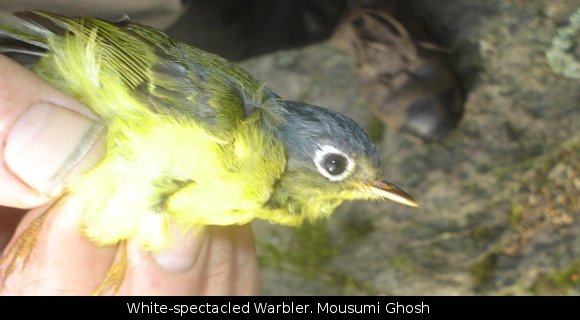
The same attributes which make them so difficult to identify (so many species, yet so similar in appearance) have made them one of the most well-studied groups of birds in the world. Within India, detailed studies of their breeding (in the Himalayas) and wintering ecology (Himalayan foothills, peninsular India) by Dr. Trevor Price and his students have revealed a great deal about these leaf warblers in both breeding and wintering seasons.
Read Part II of this series of articles on leaf warblers
By Ramit Singal
Ramit Singal is an engineering student studying in Manipal. He has been interested in birds ever since he was gifted Martin Woodcock’s Birds of the Indian Subcontinent about 10 years ago. Birding is now a serious hobby of his. He tries and devotes as much time to birds as possible and is trying hard to make birding an established hobby amongst students within his campus. He has been in Manipal for 2.5 years, and he (irregularly) maintains his journals at http://manipalbirding.tumblr.com/

Manipal is a small town located in the Udupi district of Karnataka, and situated quite favourably at an equal distance from the Western Ghats to the east and the Arabian Sea to the west. Manipal is best known for its university, but it is also endowed with a diverse range of habitats and, as a direct consequence, a diverse population of birds. The area hosts nearly 190 species of birds, a good 40 of which are seen only during the winter months. However, not all of them are migrants that cross international borders, or are palaeartic – many are local migrants or those that breed in the northern plains but winter in the south (Eg. Blue-tailed Bee-eater).
In terms of migrants which are palaeartic – the number drops down slightly and becomes 30, still fairly impressive. This ’30’ includes all forms of birds – waders, warblers, raptors, etc but Manipal has thus far failed to attract any wintering waterfowl, despite suitable habitat being available.
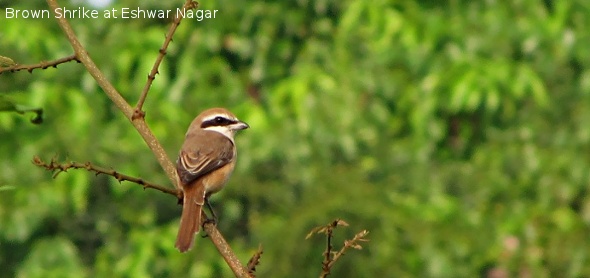
While I will get down to the nitty-gritties of the species and the frequencies of their sightings later, I want to put down a few words regarding the habitats in Manipal. There are three main different types of birding locales in this small town, all within one kilometre of the other. One of the most productive is the man-made Manipal Lake – a waterbody that dries up on the shores just in time for incoming waders to reap the benefits of the now available mudflats and vegetation. Another – and my favourite site in the region – is the Eshwar Nagar woodlands. These are basically the forests of yore, of which only a few fragments remain – the rest being grasslands (what were old paddies) or cultivation. However, there is just about enough in the area to keep it going and flourishing as a birdwatching site. Lastly, and the only site with any tourism in Manipal – End Point. This region is the edge of the plateau between the ghats and coastal plains and comprises of scrubby laterite hillsides and secondary forests.

As the monsoons end in mid September and leave behind massive puddles in the laterite patches of End Point, the first waders – usually sandpipers and sand plovers are seen. They depart as soon as the water dries up, leaving behind the right habitat for the incoming flocks of Greater Short-toed Larks and other such birds – wagtails and pipits. The waders instead move on to the much wetter and much richer ecosystem of the Manipal Lake. Aggressive Ashy Drongos also start taking over every suitable perch possible. This is also the time when the open areas within forests get their first Brown Shrikes, which are noisiest at the start as they mark out their territories for the coming winter. By the time October’s first week ends, wintering and on-passage Brown Flycatchers, Bright Green and Greenish Warblers, Booted and Blyth’s Reed Warblers, and Barn Swallows can be seen anywhere – every garden and compound. The Bright Green Warblers (subspecies nitidus of the Greenish Warblers; but often considered a separate species) are the most common winter migrants in the region, closely followed by the Acrocephalus/Hippolais warblers and Ashy Drongos.
Amidst huge flocks of Chestnut-tailed Starlings, the Eshwar Nagar woodland throws up the most fascinating birds every now and then. Apart from the recent Broad-tailed Grassbird, the winters bring to it the odd Black-naped Oriole and varying populations of Oriental Turtle Doves. It also holds the largest numbers of Green(ish) Warblers and Blyth’s Reed Warblers – the latter probably because of the extra bit of moistness early morning :-). Almost 90% of all Brown Shrikes in Manipal winter in this patch and Marsh Harriers patrol the nearby paddyfields for the odd waders, crakes, and possibly Lesser Whistling Teals.
The open grassland and scrubby vegetation that the laterite hillsides of Manipal naturally provide are good areas for the Common Stonechat – a regular but scarce visitor, a status it shares with the Tree and Blyth’s Pipits – both of which are also found in similar habitats (although the Tree Pipit does like the presence of trees around it a lot more :-). As the sun rises, the Booted Eagles also rise up with it. The Common Kestrel is a rare winter migrant here, this is the right habitat to find one. All of these arrive post mid-October in general.

Due to human intervention, these same hillsides have been flattened at the top of End Point, but this move has put the habitat in good favour with passage flocks of over 500 Greater Short-toed Larks especially on return migration in February, as well as birds like the Grey-necked Bunting, which stayed for >3 weeks in Feb 2011, and Yellow and White Wagtails, the latter of which is the commonest wintering wagtail and is present in very good numbers from late November onwards. The Grey Wagtail is surprisingly rare, only seen around the discharge streams coming from the Manipal Lake. Manipal has several fields and grounds for sports that are used in the early mornings by birds. Their moist surface again brings together a few wagtails and waders – stints and Redshanks being especially fond of such habitats.
Speaking of man-made habitats, of note perhaps is the Peregrine Falcon (subspecies calidus) that stayed for a week in October 2009 and perched regularly on the boys’ hostels in the engineering college’s campus!
All in all, while the number of migrants may not be astounding, Manipal never fails to throw in a new surprise each winter. Its geographical location makes it an ideal place for getting the odd bird on passage between the extreme south and the west. All it really needs is more eyes to be on the lookout for any unusual sightings in its very varied landscape.

Here are links to Ramit’s MigrantWatch sightings and photographs.
Text and photos by Tarun Balpande
Born in Pandhurna (M.P.) and settled in Nagpur, Tarun Balpande works as an Area Manager in the Oncology division of a pharmaceutical company. He was drawn into the excitement of birding five years ago, when he took part in a Great Indian Bustard census. After observing migrating Bar-headed Geese, he now concentrates on migratory birds. He also works on the importance of planting fruit-bearing trees, and on getting a bird-feeder in every home in Nagpur.
In 2008, I came to know through the nagpurbirds e-group, run by Tarique Sani, that several Bar-headed Geese had been collared in Mongolia. In November of that year, Raju Kasambe and I started searching around Nagpur for Bar-headed Geese to check for a collar. At one point, Raju Kasambe spotted “something” yellow on the neck of a goose, but our limited optics didn’t allow us to see it clearly.
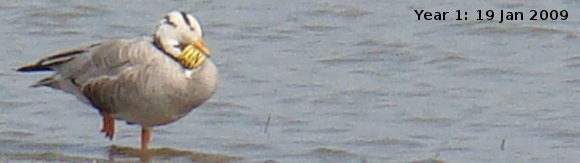
But the big day finally came!! On 19 January 2009, my wife Rakhee, son Chaitanya and I, together with Kishor Khandekar were watching a group of Bar-headed Geese, when I suddenly noticed a goose with a 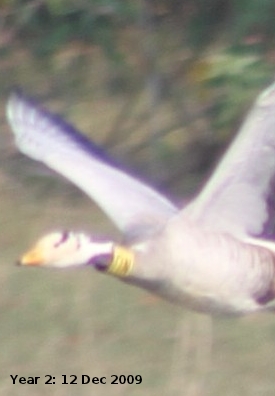 yellow collar around its neck. Through my binoculars I could read the letters “NU”, and I was able to click a few images with these letters clearly visible. But what did “NU” mean?
With the help of Raju Kasambe and Tarique Sani, I came to know that black lettering on a yellow collar meant that the goose had been marked in Mongolia. Martin Gilbert informed me that NU was an adult female, captured on 17 July 2008 in the Darkhad Valley, Hovsgol province of Mongolia.
Many Bar-headed Geese had been collared there to understand the migration of this species. These birds were collared by a team led by Martin Gilbert, of the Wildlife Conservation Society, Mongolia. A number of species have been marked using different techniques appropriate for each species. The Bar-headed Geese were marked with a neck collar inscribed with a unique alphanumeric code.
All this happened 4800 km away! The Bar-headed Goose we sighted was at Paradgaon lake, which is situated on the Umred road, around 28 km from Nagpur. The entire season myself and other fellow birders were looking for a collar other than NU, but no one find another collared Goose. At the end of the migration season, we were all looking forward to the next season — NU had left us with wonderful memories.
Next season, on 5 November 2009, Raju Kasambe recorded the first arrival of a flock of 300 Geese at Paradgaon lake. 0n 12 December 2009, I clicked a photo of my old Mongolian girlfriend NU! This affair continued in 2010, when I photographed her again on 26 November. I emailed a message to Martin Gilbert, and he replied: “How good to hear from you again, and thank you so much for sending your sighting! …it is indeed great news that you have been able to relocate NU once again, and I believe this is the first time that we have had any bird resighted in three consecutive years!”. This is the best appreciation for any birdwatcher.
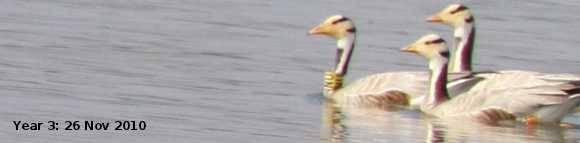
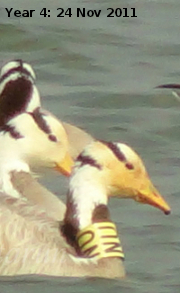 This year, 2011, I started monitoring the lake from 10 November. On 24 November 2011, Rakhee, Chaitanya and I, together with birdwatcher Avinash, saw a flock of 275-300 Bar-headed Geese. I started searching the flock for NU. Euphoria !!! she was there !!! As usual I clicked a few photos.
I am proud to report that NU visits Paradgaon lake for the fourth consecutive year! The exact location of the lake is: 20°92’58.06″N 79°22’24.14″E
You can see all of Tarun Balpande’s reports on MigrantWatch.
For other reports of marked birds from Mongolia, look at this page on Birds of India. And a copy of a message from Martin Gilbert is here.
For more information about Bar-headed Geese, including some recent information on their migration, take a look at this species profile on the MigrantWatch blog.
This article, in The Hindu, titled “Migratory birds declining, government monitoring habitat“, describes Environment and Forests Minister Jayanthi Natarajan’s reply to a query in the Lok Sabha.
There are various interesting tidbits in the article, including this statement, presumably taken from the ZSI Handbook that is mentioned in the previous paragraph in the article:
“The most abundant winter migrants to the Indian subcontinent are ducks and geese. Both constitute about 85 per cent of the population.”
What do you think? Which species is likely (in your estimation) to be the most abundant winter visitor to India? Do write your answers in the comments section below.
By Suhel Quader
Up to 11 Oct 2011, 9900 sightings had been reported to the MigrantWatch database. This information is meant to be used, so at MigrantWatch we are gathering our thoughts to put together a comprehensive summary of the data that the project has gathered since it started in July 2007. When it is ready, we’ll send the report to all MigrantWatch participants, with grateful thanks.
In preparing the report, we have been thinking about how best to show a picture of arrival dates of different species (for example, see a crude attempt here). In this post, I’d like to show you some first attempts, and ask for your feedback on improvements and additions.
The picture below shows sighting information from all years of the project (until 11 October 2011) and across all India, for the 23 winter migrants for which there are at least 100 records in the database. Each short vertical line depicts a sighting. The dates are arranged from July to July, corresponding with a typical migration season (rather than a calendar year). To help see the patterns of first sightings, it’s better not to focus on the very earliest sighting dates and instead look at when the main concentration of first sightings is. The yellow boxes in the picture depict when the earliest 1% to 5% of sightings happened. (This is just like the percentile rankings that students get on some exams.) The width of the yellow boxes indicates how spread out the arrival is for each species: wide boxes mean that the earliest sightings are spread out considerably in time. In the picture below, species are arranged in order of the earliest 1% of arrivals (ie, the left edge of the yellow boxes).
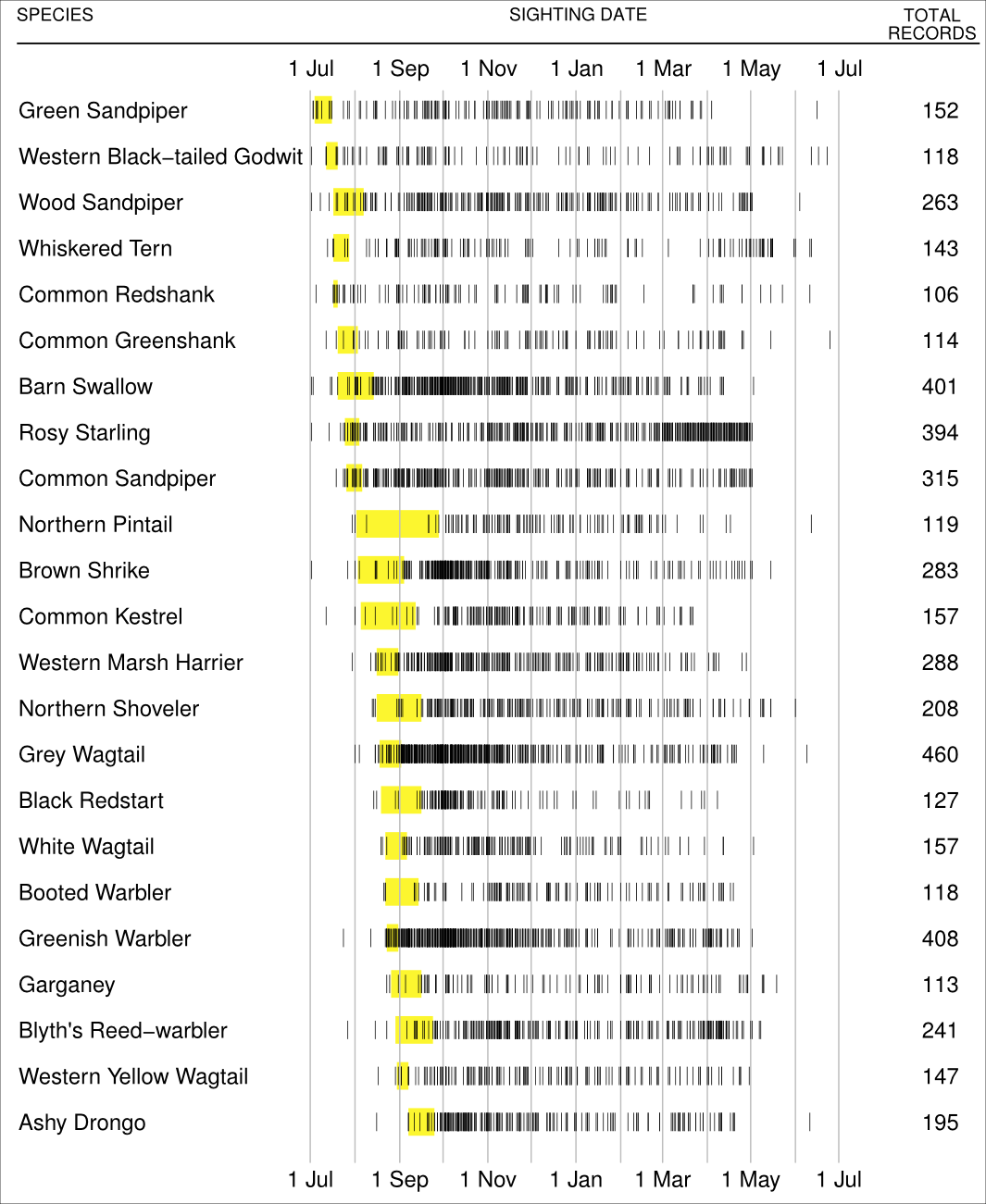
What does this summary tell us? We see that shorebirds form a large proportion of early arriving species, which confirms what I’m sure many of us have casually noticed. Ducks tend to turn up a bit later, as also wagtails and warblers. Although only a few MigrantWatch participants keep an eye out for departing migrants (and so information from the end of the season is thin), it seems as though most migrants have left the country by the beginning of May. The departure appears particularly abrupt for species like Rosy Starling, Common Sandpiper, Greenish Warbler and Blyth’s Reed-warbler. Individuals of other species hang on for a while, and several shorebirds have been seen well into June, possibly birds who have decided to skip their return flight altogether and instead over-summer in India.
Of course, this all-India picture obscures variation in migration dates in different parts of the country: migrants don’t suddenly appear everywhere at the same time! To try to look for geographical differences, we have grouped sightings into five regions (excluding the Andaman and Nicobar Islands, and Lakshadweep): North-East, North-West, North, Central, and South. Region-wise sightings for two migrants are illustrated below.
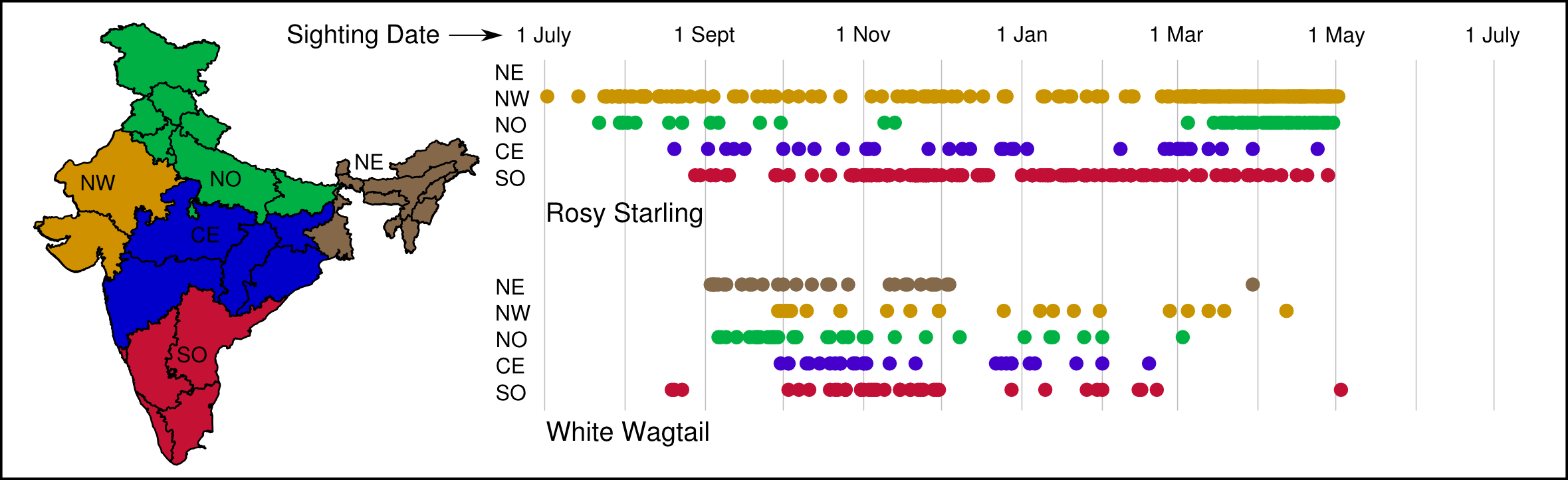
Rosy Starlings first appear in the North-West, as might be expected from their breeding grounds (Eastern Europe to Kazakhstan). Their early initial arrival, in beginning July, is followed by a gradual and unhurried trickle-down to other parts of the country (except to the North-East, where the species does not occur). It takes nearly two months for these birds to reach the South. In contrast, departure dates are more uniform, all around end-April, presumably as the birds hurry back en-masse to their breeding grounds.
In contrast, White Wagtails put in a much later first appearance, starting in the North-East and North (apart from a couple of oddly early sightings in the South). They then appear relatively rapidly in North-West, Central and South — in roughly the opposite East-West sequence as Rosy Starlings. Departure of White Wagtails is less clear, because of the low number of observations.
Do these visual depictions of MigrantWatch information make sense? Are they useful? How can we improve them? Are they too simple? Too complicated? Please do let us know in the comments below; we would like to summarise the data in a manner that is of most use and interest to you! (Of course, as always, you can play around with the data yourself — just login and click on view data/maps to download the entire database.)
And please don’t forget to report your migrant sightings. MigrantWatch is no more and no less than the sum of contributions of all participants; to paint a clear picture of bird migration, the more reports (of first, and last, and general sightings) the better!
Many birders who keenly monitor wetlands across the country have had a somewhat disquieting year. It seems that several migratory birds across the country have been giving some of their usual haunts a miss. Newspaper articles1-6 over the past months have reported lower number of birds or few species of birds from wetlands across the country. Even some of the most widespread and common migrants like the Garganey have not been seen at a number of locations across their recorded distribution in India.
Reports from the latest Asian Waterbird Census suggest that a number of regular migrants at Delhi’s Okhla Bird Sanctuary, like the Black-tailed Godwit and Garganey (photo), did not turn up this year, while several other species like Gadwall and Bar-headed Goose arrived in much smaller numbers1,2. Similar patterns have been reported from the Keoladeo Ghana National Park in Bharatpur3 and sites across Maharashtra4 and Karnataka5,6.
The media reports, mostly informed by local expertise, have suggested that apart from the usual suspect (habitat loss), unseasonal rains just before the onset of winter are a major reason for the altered patterns. The most severely affected habitats appear to be natural and man-made wetlands that lie downstream of large dams in rain-affected areas. The argument is that water released from the dams submerged islands presumably making conditions unfavourable for a number of species such as the Garganey that forage in shallow water.
MigrantWatch Data
A glance at the MigrantWatch data also seems to suggest that some of the species have been reported from fewer locations this year as compared to last year. (Links lead to MigrantWatch data on the species.)
The Garganey (Anas querquedula) was not reported from Hyderabad, Pune and Nagpur this season (2010-2011) but it was reported from these locations last season (2009-2010). The Mallard (Anas platyrhynchos) was reported from Jamnagar in Gujarat and Udaipur in Rajasthan last season (2009-2010) but not this season. The Common Pochard (Aythya farina) during 2010-11 has been reported less than half as often and from far fewer locations than during the 2009-10 or 2008-09 seasons. The Tufted Duck (Aythya fuligula) was only reported from Uttarakhand, Goa and two locations in Gujarat this season; last season it was also reported from locations in Uttar Pradesh, Delhi, Rajasthan, Himachal Pradesh and Madhya Pradesh. The Black-tailed Godwit also was not reported from locations in Goa, Kerala and Karnataka this season.
We should caution that these findings (about MigrantWatch sightngs) should not be taken as definitive. Since the total number of sightings reported to MigrantWatch in the 2010-2011 season is lower than in the previous season (1,887 versus 2,745), it is possible that the absence of species from particular sites or States may simply reflect the lower reporting rate. Note also that MigrantWatch does not have the goal of assessing year-to-year changes in species distribution or abundance — for that, the Asian Waterbird Census is the appropriate source of information.
Still, sightings reported to MigrantWatch contribute to an overall picture of what is happening to our migrant species. So please do upload your sightings for this season to MigrantWatch so that the combined information becomes more and more valuable.
While it is not new that climate (including rainfall) can affect the distribution of waterbirds, much remains unknown. For instance, where do the displaced migrants go? Do they merely redistribute themselves locally, moving to other wetlands created by the rains? Or, do the changes in rainfall patterns bring about much larger-scale changes in bird migrations? If you have information or an opinion on these questions, please do add a comment to this post.
Newspaper Articles –
1. Some sightings, several misses at Asian waterbird census; Hindustan Times, New Delhi, January 24, 2011
2. Migratory bird count falls sharply in Delhi; The Hindu, New Delhi, March 08, 2010
3. Jairam blasts Gehlot over dry Bharatpur sanctuary; The Pioneer, New Delhi, November 26, 2010
4. Migratory birds fail to weather rain, fall in numbers; The Times of India, Pune, December 11, 2010
5. Migratory bird numbers go south; The Hindu, Mysore, December 22, 2010
6. Urban migration? Not anymore for Bangalore birds; Express Buzz, Bangalore, Feb 16, 2011
By Nimesh Ved
Nimesh Ved works in conservation education across different segments of society in south Mizoram. While doing so, he finds himself lucky to expand his awareness and appreciation of wildlife in north-eastern India.
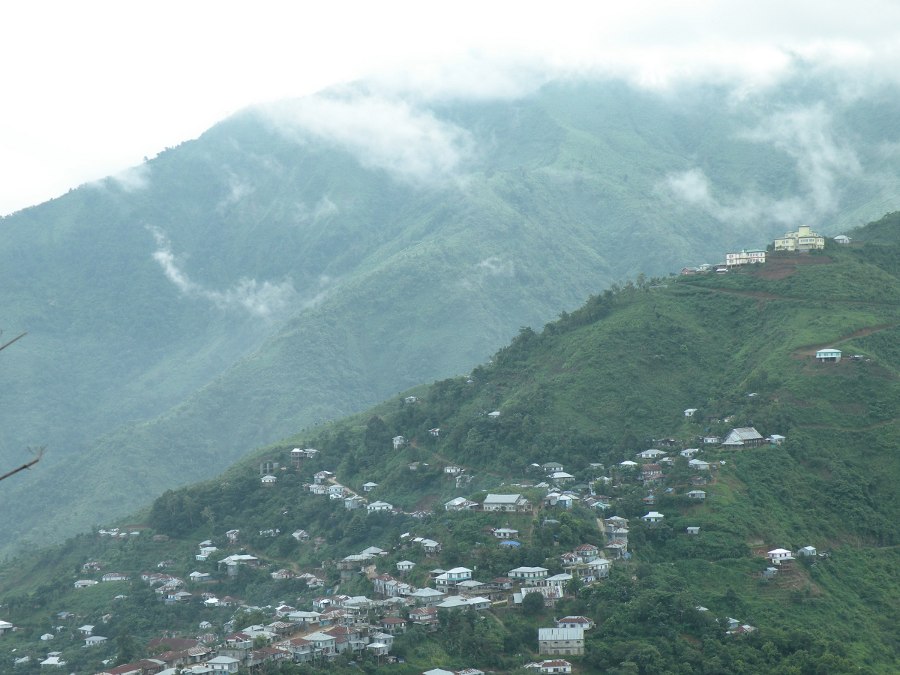
Saiha, at the southern tip of Mizoram, has offered me many sightings of avian migrants during my three years of working here as the head of the Samrakshan Trust’s conservation education efforts. A sighting of the Common Kestrel Falco tinnunculus was one of my first contributions to the MigrantWatch database last year; and this year too they came back to Saiha to fill my winter months with some memorable sights.
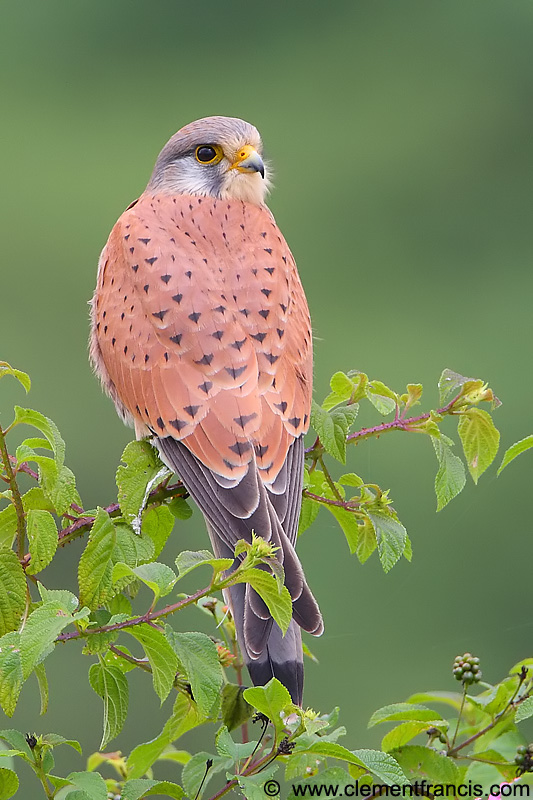 My first sighting of kestrels in the current season was when we saw two of them take small dives in mid-air, turning (almost!) on their sides and catching insects; this spectacle went on for 15 min. It was fun to see small insects disappear amidst this ‘dance’ of the kestrels; as I write I recall Kipling’s eloquent narrative of the ‘Dance of Elephants’ in his ‘Toomai of the Elephants’. We just sat there at our base-camp and soaked in this sight.
On later occasions, we have heard their high-pitched calls at about 6 in the morning, as if chastising us for not making an early start to the day.
One evening at about 4 pm we saw about 20 to 25 Kestrels flying in circles about 30 feet above the ground. There was a fire in the valley and they were presumably enjoying feeding on the insects that fled the fire. It was mesmerising to see the kestrels moving around in joy like children coming out of school. This also led me to look up literature on the Lesser Kestrel Falco naumanni that I thought was a part of that day’s excitement.
Confusions on raptors has often led me to Rishad Naoroji’s book Birds of Prey of the Indian Sub-continent and here I found some of the day’s observations to be in consonance with his notes on the Lesser Kestrel – “Essentially insectivorous, highly social and flocking species”; “Taking prey (mostly insects) more often on the wing than the Common Kestrel, otherwise hunts similarly but mostly in small groups or large loose flocks, 10 m to 15 m above the ground”; “In Africa catches insects disturbed by grass fires in the air”. Next I checked up the web to confirm calls of the Common Kestrel and Lesser Kestrel. While most of the calls I had noticed belong to the Common Kestrel, the call I had heard today (15 Nov 2010, 1:45pm) was that of the Lesser Kestrel, which has a lower-pitched and harsher voice.
How exciting to confirm that the rare Lesser Kestrel visits Saiha! It would be wonderful to know where they come from and how long they spend here.
Some notes on Kestrels from the literature
About Indian Birds by Salim Ali and Laeeq Futehally ~ ‘There is only one bird which can really remain quite stationary, in the air, even when its wings do not move, and that is the kestrel.’
A Pocket Guide to the Birds of Mizoram by Anwaruddin Choudhury ~ Common Kestrel is a common winter visitor to Mizoram.
Relevant Links
BirdLife International’s summary sheets on Common Kestrel and Lesser Kestrel
Calls of Common Kestrel and Lesser Kestrel
MigrantWatch data on Common Kestrel and Lesser Kestrel.
Nimesh Ved blogs here. He can be contacted at nimesh.ved [at] gmail.com.