MigrantWatch

MigrantWatch archive (2007–2015)
Report migrant sightings on eBird India · about this archive

Cranes flying against an orange sky

Category: News

MigrantWatch news

  • Results out for Great Backyard Bird Count 2014!

    Category: , ,

    GBBC 2014 was a record event for India! Over 1,100 birders participated, contributing more than 3,000 lists, which contain observations of 823 species — this is the largest number of species contributed to the GBBC by any country in the world!

    Visit this link to see the results for GBBC India, lists of participants, and other interesting details.

    Many thanks to all who contributed! But the story doesn’t end with GBBC. Here is an exciting activity for all of us to take part in — the eBirding Challenge for India — which started on 1 April 2014, and will continue all through the year.

  • Revised names for MigrantWatch species

    Category: , ,

    Species names in MigrantWatch have remained unchanged since the start of the project, and an update is long overdue. We have now changed the names of some of the species in the MigrantWatch database, following following recent revisions in taxonomy and nomenclature.

    As part of our efforts to integrate more closely with eBird, we decided to follow the eBird naming system, which, in turn, is synchronized with the Clements Checklist of the Birds of the World.

    A practical consequence of this is that it is now much easier for you to upload your MigrantWatch sightings to your eBird account if you wish to do so. Note that the scientific names of species in MigrantWatch now match Clements/eBird exactly, and the English names are the same as if you set your preferences in eBird to “English (India)” as recommended for Indian birders.

    A concise summary of changes is given below for your convenience (the complete list of changes can be downloaded here: MW name changes 2014-03-23). We urge you to refer to this list before submitting observations.

    Both English and scientific names changed

    Old name

    Updated name

    Notes

    Common Stonechat

    Saxicola torquata

    Common/ Stejneger’s Stonechat (Siberian Stonechat)

    Saxicola maurus

    The former Common Stonechat has been split, following which the  species in India is the Siberian Stonechat, S. maurus.

    Eurasian Golden Oriole

    Oriolus oriolus

    Indian Golden Oriole

    Oriolus kundoo

    The former Eurasian Golden Oriole has been split, following which the species in India is the Indian Golden Oriole, O. kundoo.

    Orphean Warbler

    Sylvia hortensis

    Eastern Orphean Warbler

    Sylvia crassirostris

    Orphean Warbler has been split, following which the species in India is the Eastern Orphean Warbler, S. crassirostris.

    English name changed

    Old name

    Updated name

    Notes

    Eurasian Skylark

    Skylark (Sky Lark)

    Grasshopper Warbler

    Common Grasshopper-Warbler

    Red-throated Flycatcher

    Red-breasted Flycatcher

    The former Red-throated Flycatcher had two subspecies, which are now recognised as separate species: Red-breasted and Red-throated. The Red-breasted Flycatcher retains the scientific name Ficedula parva, while the red-throated form is now Taiga Flycatcher Ficedula albicilla

    Red-breasted Flycatcher

    Taiga Flycatcher

    Spangled Drongo

    Hair-crested Drongo

    Hair-crested Drongo retained to prevent confusion with the Spangled Drongo found in Australia

    Scientific name changed

    Old name

    Updated name

    Notes

    Alpine Swift

    Tachymarptis melba

    Apus melba

    Asian Brown Flycatcher

    Muscicapa dauurica

    Muscicapa latirostris

    Black-headed Gull

    Larus ridibundus

    Chroicocephalus ridibundus

    Black-winged Cuckooshrike

    Coracina melaschistos

    Lalage melaschistos

    Booted Warbler

    Hippolais caligata

    Iduna caligata

    Bridled Tern

    Sterna anaethetus

    Onychoprion anaethetus

    Bristled Grasswarbler

    Chaetornis striatus

    Chaetornis striata

    Broad-billed Sandpiper

    Limicola falcinellus

    Calidris falcinellus

    Brown-headed Gull

    Larus brunnicephalus

    Chroicocephalus brunnicephalus

    Buff-breasted Sandpiper

    Tryngites subruficollis

    Calidris subruficollis

    Caspian Tern

    Sterna caspia

    Hydroprogne caspia

    Demoiselle Crane

    Grus virgo

    Anthropoides virgo

    Dusky Thrush

    Turdus naumanni

    Turdus eunomus

    The former Turdus naumanni has been split

    Eurasian Crag-Martin

    Hirundo rupestris

    Ptyonoprogne rupestris

    Firethroat

    Luscinia pectardens

    Calliope pectardens

    Great Black-headed Gull

    Larus ichthyaetus

    Ichthyaetus ichthyaetus

    Greater Spotted Eagle

    Aquila clanga

    Clanga clanga

    Grey Bushchat

    Saxicola ferrea

    Saxicola ferreus

    Heuglin’s Gull

    Larus heuglini

    Larus fuscus heuglini

    Considered subspecies of the Lesser Black-backed Gull (Larus fuscus) which has a complex taxonomy

    Himalayan Rubythroat

    Luscinia pectoralis

    Calliope pectoralis

    Indian Blue Robin

    Luscinia brunnea

    Larvivora brunnea

    Lesser Crested Tern

    Sterna bengalensis

    Thalasseus bengalensis

    Little Tern

    Sterna albifrons

    Sternula albifrons

    Pied Thrush

    Zoothera wardii

    Geokichla wardii

    Rosy Starling

    Sturnus roseus

    Pastor roseus

    Ruff

    Philomachus pugnax

    Calidris pugnax

    Siberian Blue Robin

    Luscinia cyane

    Larvivora cyane

    Siberian Rubythroat

    Luscinia calliope

    Calliope calliope

    Slender-billed Gull

    Larus genei

    Chroicocephalus genei

    Sooty Tern

    Sterna fuscata

    Onychoprion fuscatus

    Sykes’ Warbler

    Hippolais rama

    Iduna rama

    Thick-billed Warbler

    Acrocephalus aedon

    Iduna aedon

    Whiskered Tern

    Chlidonias hybridus

    Chlidonias hybrida


  • Demoiselle Crane ringed in Mongolia sighted in Rajasthan

    Category: , , ,

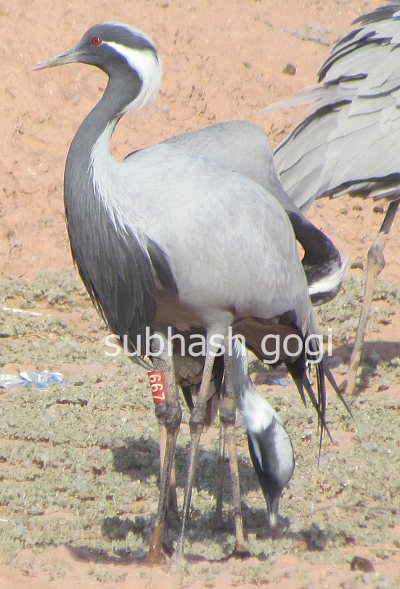
    Demoiselle Crane ringed - Subhash Gogi (copy)MigrantWatcher Subhash Gogi spotted and photographed a ringed Demoiselle Crane at Khichan village, Jodhpur district, Rajasthan on the afternoon of 6th March 2014. The ring on the bird was red-coloured and bore the number 667.

    Further inquiries revealed that the crane was originally ringed in Mongolia on 24th July 2013.

    We encourage MigrantWatchers to keep a lookout for ringed birds, as they provide vital information about the fascinating phenomenon of bird migration, which is still poorly understood.

    Photo: Subhash Gogi


  • Tagged Bar-headed Goose sighted again!

    Category: , ,

    Bar-headed goose - Prabhat Bhatti - croppedResighting of previously-tagged birds always generates a lot of excitement as it provides crucial information about migration patterns. The odds of sighting a tagged bird again are very low. So, it was a indeed a stroke of good luck when a tagged Bar-Headed Goose (bearing the tag ‘H55’) was seen and photographed by Parbhat Bhatti in Rupnagar in Punjab.

    Read more about this interesting sighting in this news article by Vikram Jit Singh in The Hindustan Times. [Photo courtesy Parbhat Bhatti]


  • 25,000th sighting on MigrantWatch!

    Category: , ,

    MigrantWatch reached yet another landmark with the logging of the 25,000th record — a White Wagtail by Nil N. Mohite. Remarkably, this sighting was from Amravati (Maharashtra) again! It may be noted that Amravati also has the distinction of reporting the 10,000th, 15,000th, as well as the 20,000th observation on MigrantWatch!

    Hearty congratulations to everyone from the MigrantWatch community who contributed to this effort!

  • MigrantWatch round-up: July 2013

    Category: , ,

    The latest news at MigrantWatch has been emailed to all participants via the July 2013 issue of the monthly round-up. If you are registered with us, but haven’t received this email, please check your spam folder; and add mw@migrantwatch.in to your address book. Please send us a message if you have any questions.

  • MigrantWatch round-up: June 2013

    Category: , ,

    The latest news at MigrantWatch has been emailed to all participants via the June 2013 issue of the monthly round-up. If you are registered with us, but haven’t received this email, please check your spam folder; and add mw@migrantwatch.in to your address book. Please send us a message if you have any questions.

  • MigrantWatch round-up: May 2013

    Category: ,

    The May 2013 issue of the monthly round-up of the latest news at MigrantWatch has been sent to all participants. If you are registered with us, but haven’t received this email, please check your spam folder; and add mw@migrantwatch.in to your address book. Do send us a message if you have any questions.

  • MW round-up: March 2013

    Category: ,

    The March 2013 issue of the monthly round-up of the latest news at MigrantWatch has been sent to all participants. If you are registered with us, but haven’t received this email, please check your spam folder; and add mw@migrantwatch.in to your address book. Do send us a message if you have any questions.

  • Does the Pied Cuckoo herald the monsoon?

    Pied Cuckoo-4yrs

    Does the arrival of the Pied Cuckoo herald the onset of the monsoon? The Pied Cuckoo Campaign was launched in 2009 to collect information to assess this age-old belief.

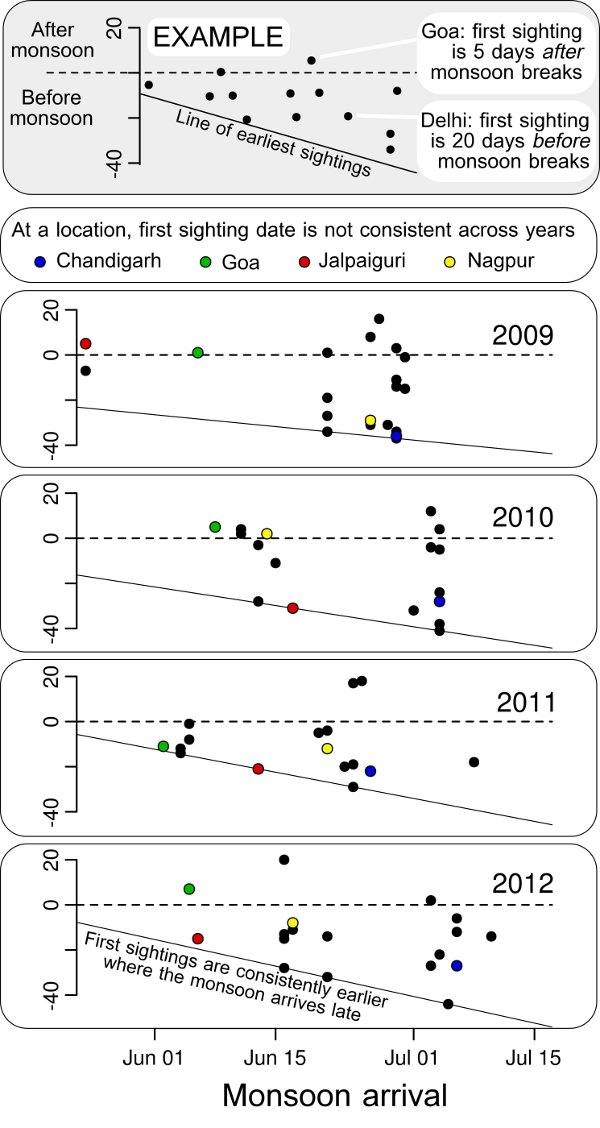
    More than 600 sightings of this wonderful migrant have been contributed by over 200 MigrantWatchers so far; the first sighting dates among these were compared to monsoon arrival, as available with the Indian Meteorological Department (see the graph alongside). Each dot shows the earliest Pied Cuckoo report (after 1 May) for a broad location (an area roughly 200 Km across).

    The results are fairly clear: Pied Cuckoos arrive before the monsoon in most parts of central and northern India (they are resident in southern India). You can see this from the pattern that most dots in the picture to the right are below the dotted horizontal line.

    But the degree to which the arrival of the Pied Cuckoo precedes the monsoon varies from place to place, as can be seen from the scatter of the dots within each year. And even for the same general location, this varies from year to year (see how the coloured dots are in different places in different years).

    What appears to be happening is that, where the monsoon arrives early, Pied Cuckoos arrive a few days before monsoon onset; but where the monsoon arrives late, the cuckoos arrive well in advance of monsoon onset.

    So, overall, the old belief is true, and Pied Cuckoos tend to arrive before the monsoon — but to different degrees, depending on when the monsoon begins at each place.

    Also see this article on Pied Cuckoo migration.