MigrantWatch

MigrantWatch archive (2007–2015)
Report migrant sightings on eBird India · about this archive

Cranes flying against an orange sky
  • Where have the migrants gone?

    Category: ,

    Many birders who keenly monitor wetlands across the country have had a somewhat disquieting year. It seems that several migratory birds across the country have been giving some of their usual haunts a miss. Newspaper articles1-6 over the past months have reported lower number of birds or few species of birds from wetlands across the country. Even some of the most widespread and common migrants like the Garganey have not been seen at a number of locations across their recorded distribution in India.

    Reports from the latest Asian Waterbird Census suggest that a number of regular migrants at Delhi’s Okhla Bird Sanctuary, like the Black-tailed Godwit and Garganey (photo), did not turn up this year, while several other species like Gadwall and Bar-headed Goose arrived in much smaller numbers1,2. Similar patterns have been reported from the Keoladeo Ghana National Park in Bharatpur3 and sites across Maharashtra4 and Karnataka5,6.

    The media reports, mostly informed by local expertise, have suggested that apart from the usual suspect (habitat loss), unseasonal rains just before the onset of winter are a major reason for the altered patterns. The most severely affected habitats appear to be natural and man-made wetlands that lie downstream of large dams in rain-affected areas. The argument is that water released from the dams submerged islands presumably making conditions unfavourable for a number of species such as the Garganey that forage in shallow water.


    MigrantWatch Data

    A glance at the MigrantWatch data also seems to suggest that some of the species have been reported from fewer locations this year as compared to last year. (Links lead to MigrantWatch data on the species.)

    The Garganey (Anas querquedula) was not reported from Hyderabad, Pune and Nagpur this season (2010-2011) but it was reported from these locations last season (2009-2010). The Mallard (Anas platyrhynchos) was reported from Jamnagar in Gujarat and Udaipur in Rajasthan last season (2009-2010) but not this season. The Common Pochard (Aythya farina) during 2010-11 has been reported less than half as often and from far fewer locations than during the 2009-10 or 2008-09 seasons. The Tufted Duck (Aythya fuligula) was only reported from Uttarakhand, Goa and two locations in Gujarat this season; last season it was also reported from locations in Uttar Pradesh, Delhi, Rajasthan, Himachal Pradesh and Madhya Pradesh.  The Black-tailed Godwit also was not reported from locations in Goa, Kerala and Karnataka this season.

    We should caution that these findings (about MigrantWatch sightngs) should not be taken as definitive. Since the total number of sightings reported to MigrantWatch in the 2010-2011 season is lower than in the previous season (1,887 versus 2,745), it is possible that the absence of species from particular sites or States may simply reflect the lower reporting rate. Note also that MigrantWatch does not have the goal of assessing year-to-year changes in species distribution or abundance — for that, the Asian Waterbird Census is the appropriate source of information.

    Still, sightings reported to MigrantWatch  contribute to an overall picture of what is happening to our migrant species. So please do upload your sightings for this season to MigrantWatch so that the combined information becomes more and more valuable.


    While it is not new that climate (including rainfall) can affect the distribution of waterbirds, much remains unknown. For instance, where do the displaced migrants go? Do they merely redistribute themselves locally, moving to other wetlands created by the rains? Or, do the changes in rainfall patterns bring about much larger-scale changes in bird migrations? If you have information or an opinion on these questions, please do add a comment to this post.


    Newspaper Articles –
    1. Some sightings, several misses at Asian waterbird census; Hindustan Times, New Delhi, January 24, 2011
    2. Migratory bird count falls sharply in Delhi; The Hindu, New Delhi, March 08, 2010
    3. Jairam blasts Gehlot over dry Bharatpur sanctuary; The Pioneer, New Delhi, November 26, 2010
    4. Migratory birds fail to weather rain, fall in numbers; The Times of India, Pune, December 11, 2010
    5. Migratory bird numbers go south; The Hindu, Mysore, December 22, 2010
    6. Urban migration? Not anymore for Bangalore birds; Express Buzz, Bangalore, Feb 16, 2011

  • World Wetlands Day

    Category:

    2 Feb 2011; World Wetlands Day marks the date of the signing of the Convention on Wetlands, called Ramsar Convention, on 2 February 1971, in the Iranian city of Ramsar.

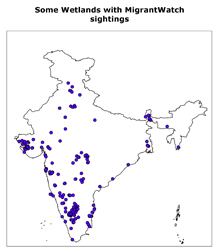
    Wetlands in India come in a variety of forms ranging from small village tanks to large river systems and backwater lakes. Wetlands are exciting and vibrant ecosystems which host a wide variety of species. Over winter, Indian wetlands attract a large number of migratory birds. Nearly one-third of the species on the MigrantWatch list are birds that  live on wetlands or extensively use wetland habitats. Some prominent visitors include several species of migratory geese, cranes, storks and flamingos.

    MigrantWatchers across India have diligently monitored numerous wetlands over the past few years, generating valuable data from not only popular locations such as the Chilika lagoon, but also several lesser-known wetlands that dot the countryside.

    Wetlands are highly threatened ecosystems and are declining at an alarming rate. Among the plethora of threats they face, over-exploitation, drainage for land development and pollution are among the most prominent. There is a pressing need for increased awareness and action to conserve wetlands.

    Join us in celebrating Wetlands Day. Wetlands Day works as a reminder of the crucial services that these fast disappearing habitats provide not just to us but also the birds that we love to watch.


  • Species profile: Bar-headed Goose

    Category:

    Every year, thousands of Bar-headed Geese make an epic journey, twice crossing the mighty Himalayas over some of the highest peaks in the world. In doing so, they fly higher than any other bird in the world and faster than most others. It’s an inspirational story of tenacity and physical endurance, which even inspires poetry (of a sort!) in some people. Read on to learn more about this fascinating species.

    Size: 71-76 cm; Weight: 2-3 Kg. Unmistakable; sexes alike; juvenile has pale grey head and neck with brown stripe running though eyes, across crown and backward down the neck. Forages mostly on land by grazing; feeds on grasses, roots, stems, sea-weeds on coasts, etc. Breeds on mountain lakes generally at 4,000-5,000m in the Palaearctic region and winters in the lowland swamps and lakes in India and some neighbouring countries.1
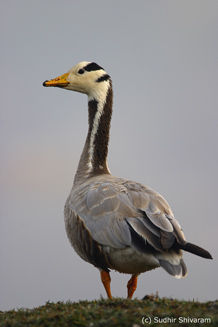
    The Bar-headed Goose is among our most good-looking and charismatic migrants; but there is more to this beauty than meets the eye. Every year the species embarks on one of the most incredible high altitude migrations known from the avian world.

    The Bar-headed Goose breeds near wetlands across the vast trans-Himalayan highland, and further north in Central Asia. During winter, a large number of these birds migrate to the Indian subcontinent, crossing the towering Greater Himalayan range before panning out across the region, all the way to Kanyakumari. Incredibly, some populations are known to over-fly the very highest peaks, 8km above sea-level, where the air is extremely thin (Oxygen pressure only a third of that at sea level) and incredibly cold (sometimes below -50 degrees C) 2. A recent study that tracked the migration of Bar-headed geese using satellite telemetry states that “The bar-headed geese… actually crossed mountain areas regardless of their height and did not avoid even very high summits… (One of the individuals) had to overcome the Tien Shan Mountains and the Alai Range, with summits up to 7km above sea level.3”

    This migration is remarkable not only because of the altitude at which the birds fly but also the speed at which it happens. Using jet streams these birds can achieve speeds of over 150km per hour, and cover distances of 700-1,000km in a single day 2. In other words, an individual that takes off from a wetland in north India, reaches altitudes over 7km in a few hours, crosses the Himalayas, and lands in Tibet, all in the same day!

    Bar-headed Geese have physiological adaptations that help it achieve this feat of a migration that few other animals can possibly survive2. It has a large heart which beats extraordinarily fast and haemoglobin with a remarkably high affinity to oxygen making it possible for the bird to take on high-altitude flight without any time to acclimatise2. Also, their wings are rather large and they are powerful flappers4.

    So this is clearly a star migrant that is built to fly high. But why it chooses to fly over the highest peaks instead of using lower passes is a question yet to be answered.
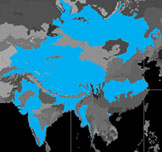
    The current global population of the species is estimated at around 52,000-60,000 mature individuals and a range (breeding and winter) of 2,370,000 sq km 5. But it is possible that the distribution of the species might be dramatically altered in the future because of global warming, change in agricultural patterns, the creation of wildlife reserves in Tibet, and loss of wetland habitat in the wintering grounds6.

    Global Distribution Map © WWF Wild Finder


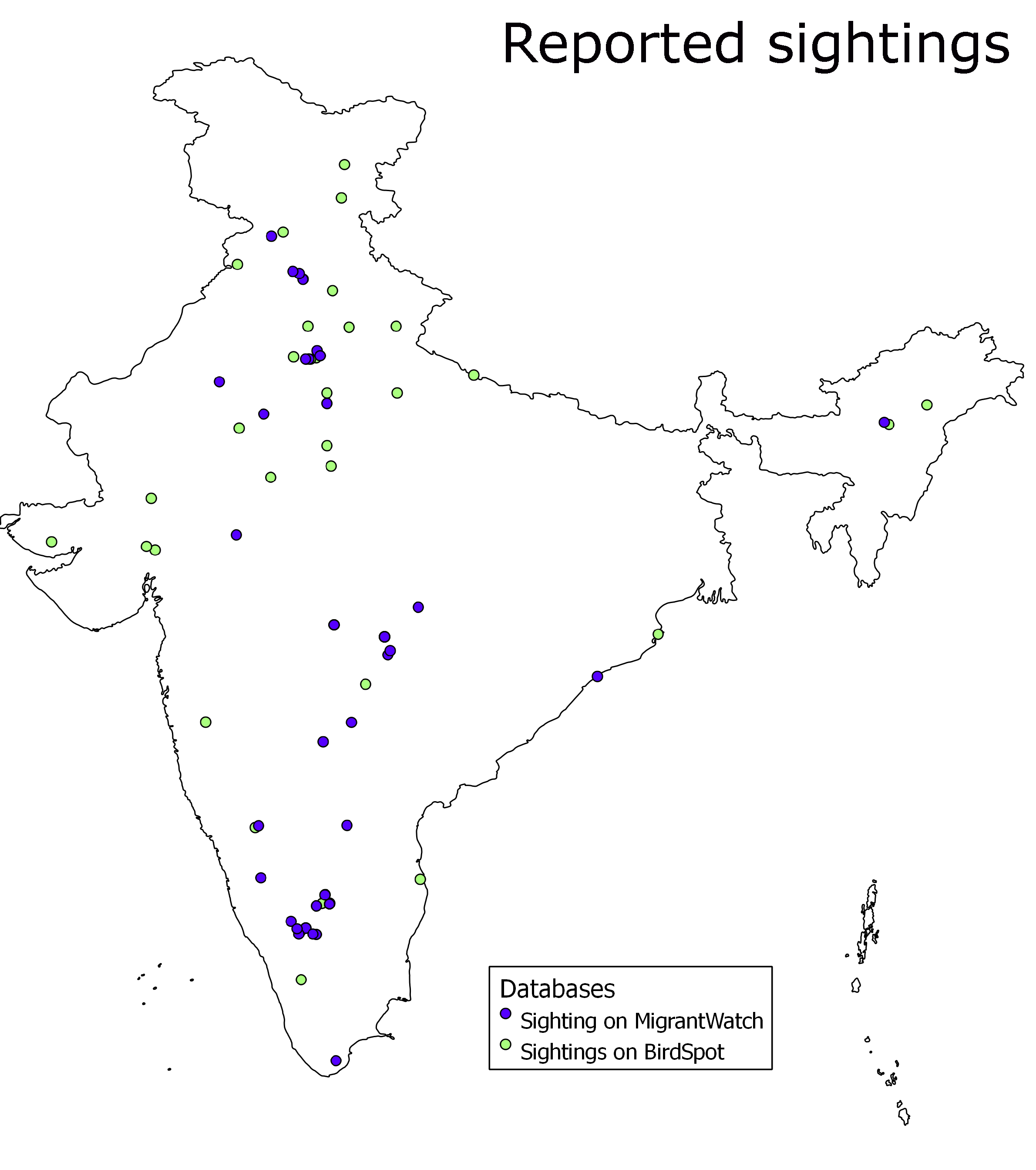
    In India, we have a population of the Bar-headed Goose that breeds in the wetlands of Ladakh, but for the rest of the country, this species is a winter migrant7. Its distribution in winter stretches across the northern plains and southwards to the southern most tip of the country8.
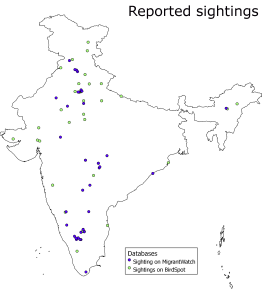
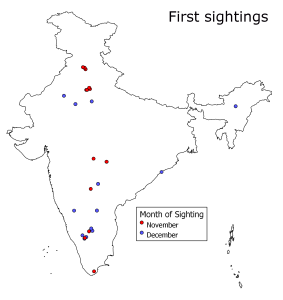


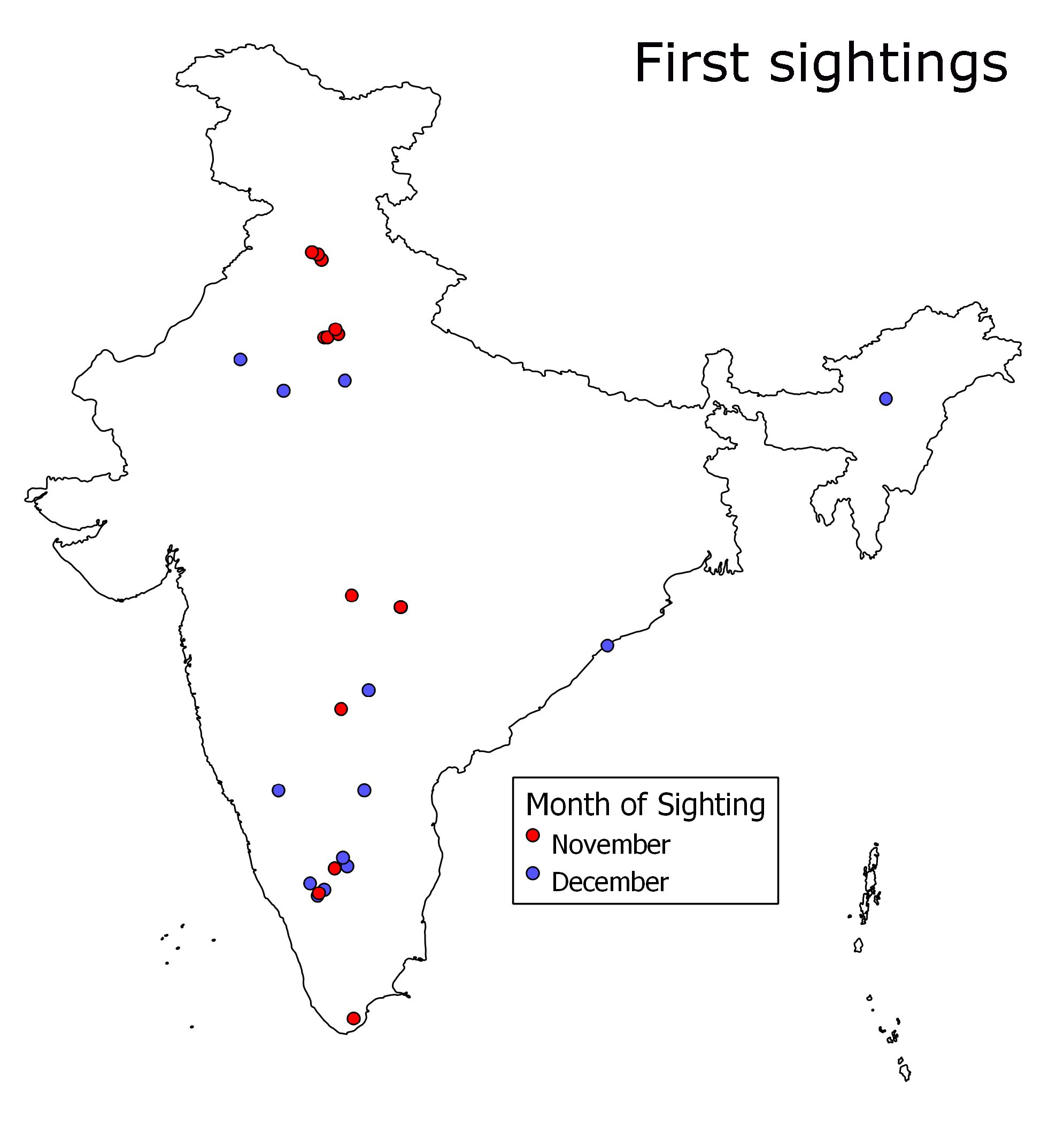
    MAPS – (a) Sightings on MigrantWatch and BirdSpot9 (b) First sightings (2008 to 12 Dec 2010) in the MigrantWatch database

    The birds arrive in India in November and migrate back to their breeding areas around mid March6. According to MigrantWatch data, the species is usually first sighted across the northern pains in Nov-Dec and in south India in Dec-Jan.

    Conservation

    The Bar-headed Goose is currently categorized as ‘Least Concern’ under the IUCN Red List, which means that it is not considered to be under threat. However, there are reports that the population has been affected adversely in recent decades due to hunting by humans, unsustainable levels of egg collecting and habitat destruction1,3. In addition to persecution by humans, this species is also known to face serious threats from disease. High mortality of these birds was recorded from lakes in China in 2005 during an outbreak of the H5N1 strain of avian influenza 2. The species may also be sensitive to climate change if migration patterns become mistimed with periods of peak food availability during the breeding season6.

    Satellite tracking

    In recent years some research on the migration of this goose has been taken up using satellite telemetry. One such study found that the individuals that were captured in the wintering grounds of India-Nepal migrated distances of 500-800 km and climbed more than 4.5 km to reach their breeding grounds on the Tibetan plateau. Geese captured in China were found to be breeding and wintering in relatively higher elevations – wintering at 4,000 m and breeding at 3,200 m, but migrating 400-800 km farther than the geese from India-Nepal. Finally, geese captured in Mongolia demonstrated a leapfrog migration – i.e. they were flying over the other sub-population from their wintering grounds in the Indian subcontinent to their breeding grounds in Mongolia 6.
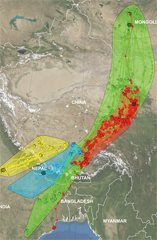
    MAP – Locations (circles), migration pathways (lines), and capture areas for 60 Bar-headed Geese marked with satellite transmitters in China (red), India (yellow), Mongolia (green), and Nepal (blue). The red-dotted line between China and Mongolia represents a goose marked pre-breeding (April) at Qinghai Lake, China which migrated to Mongolia for breeding; all other red lines represent birds marked post-breeding at Qinghai Lake.6

    Another study that followed migratory geese in Kyrgyzstan fond that the four individuals marked in Kyrgyzstan followed three completely different migration routes leading to their wintering areas in Pakistan, India and Uzbekistan via southern Tajikistan and in western Tibet 3. The study also recorded flight speeds of up to 680 km per actual migration day, even during crossings of very high summits 3.


    The Bar-headed Goose is a remarkable bird in many ways. It is amazing think that these birds can simply wake up one morning, take a test flight to check the winds, and decide to simply fly over the highest mountain range on the planet. How lucky we are to be on the other side of this flight to see these geese land noisily on our waterfront!
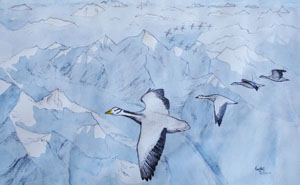


    The Anser – by Uttara Mediratta & M. O. Anand

    How many peaks must a goose fly above
    before it can earn its stripes?
    Now, how many days must a goose fly strong
    before it reaches its home?

    Yes, how many blizzards must it face
    before it can see the sun?
    The
    Anser my friend is blowin’ in the wind
    The
    Anser is blowin’ in the wind …

    (with partial credit to Bob Dylan)

    Illustration – Sartaj Ghuman

    References

    1. del Hoyo, J., Elliott, A. & Sargatal. 1992. J. Handbook of the Birds of the World: Vol 1 : Ostrich to ducks.  Lynx Edicions.

    2. Newton, I. 2008. The Migration Ecology of Birds.  Elsevier Academic Press.

    3. Köppen, U., Yakovlev, A.P., Barth, R., Kaatz, M. & Berthold, P. 2010. Seasonal migrations of four individual bar-headed geese Anser indicus from Kyrgyzstan followed by satellite telemetry. Journal of Ornithology 151, 703-712.

    4. Whiteman, Lily. 2000. The High Life. Audubon Magazine. Downloaded from <http://audubonmagazine.org/birds/birds0011.html>

    5. BirdLife International. (2010) Species factsheet: Anser indicus. Downloaded from <http://www.birdlife.org/datazone/speciesfactsheet.php?id=379>

    6. Takekawa, J.Y. et al. 2009. Geographic variation in bar-headed geese Anser indicus: connectivity of wintering areas and breeding grounds across a broad front. Wild Fowl 59, 102-125.

    7. Rasmussen, P.C. & Anderton, J.C. 2005. Birds of South Asia: The Ripley Guide. Volumes 1 & 2.  Lynx Edicions.

    8. Krishnan, M. Occurrence of the Bar-headed Goose (Anser indicus) in south India. Journal of the Bombay Natural History Society 84, 204

    9. Shyamal, L. BirdSpot. Accessible from <http://sites.google.com/site/birdspot/home>


    Relevant Links –

    Videos and other information on BBC Wildlife Finder

    Bar-headed Goose Bibliography on AVIS-IBIS (An Avian Information System – Indian BioDiversity Information System)

    BirdLife International’s summary sheets on Bar-Headed Goose

    Bar-headed Goose on MigrantWatch: Sighting data || Species Identification Guide


    (Update on 8 June)

    New research (by the BNHS and others) on Bar-headed Geese based on satellite-tracking shows that the geese display amazing feats while crossing the Himalayas on migration. They can climb many thousand metres in altitude in only a few hours; and do so without the assistance of tailwinds. Wonderful studies like this add greatly our understanding of Bar-headed Goose migration!

    Press coverage:
    Wise geese chase sinks a myth – Telegraph (Kolkata)
    High-flying geese don’t need winds – The Hindu
    The Most Extreme Migration on Earth? – Science Now

    The original research article:
    The trans-Himalayan flights of Bar-headed Geese.

  • Tiny birds, big journeys

    Category:

    Article on bird migration in the New Indian Express. by Raman Kumar. You can download a pdf of the article here.

  • The Sociable Network

    Category: ,

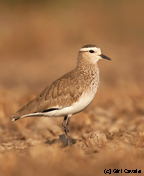
    Even if you’re not on Twitter, you can follow the exciting adventures of Dinara. This female Sociable Lapwing (Vanellus gregarius) is one among nine birds that have been fitted with state-of-the-art satellite tags by scientists at the Sociable Lapwing Project, a collaborative effort by BirdLife International, Swarovski and The Royal Society for the Protection of Birds. Thanks to ‘The Amazing Journey’ – the popular face of this project – internet users can follow, real time, the migratory movements of these birds. The tags have revealed that these nine Sociable Lapwings, which breed in Kazakhstan, overwinter in places as far apart as Saudi Arabia and India. Dinara herself was at the Little Rann of Kutch over the new year. Learn more about the life of one of the planet’s rarest birds at The Amazing Journey. And if you live close to Ahmedabad, keep an eye out for Dinara.
    Check out Sociable Lapwing data on MigrantWatch, and add your sightings!


  • Kestrels of Saiha

    Category: , , ,


    By Nimesh Ved
    Nimesh Ved works in conservation education across different segments of society in south Mizoram. While doing so, he finds himself lucky to expand his awareness and appreciation of wildlife in north-eastern India.

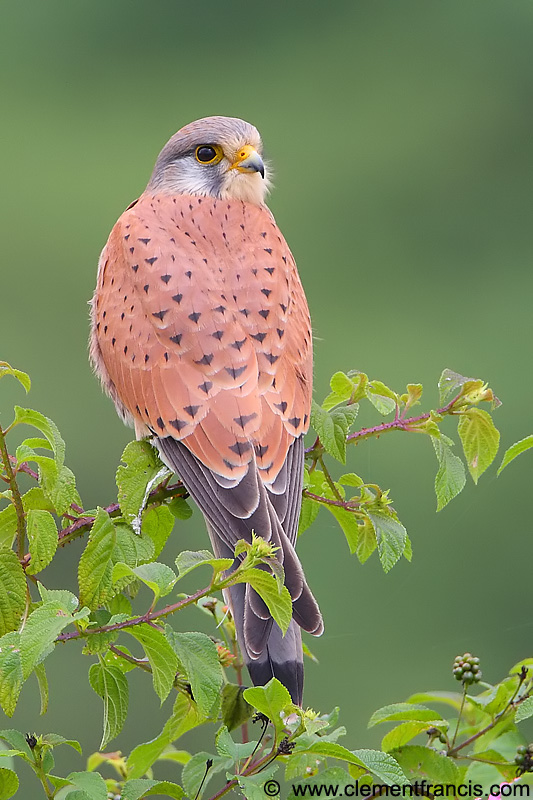
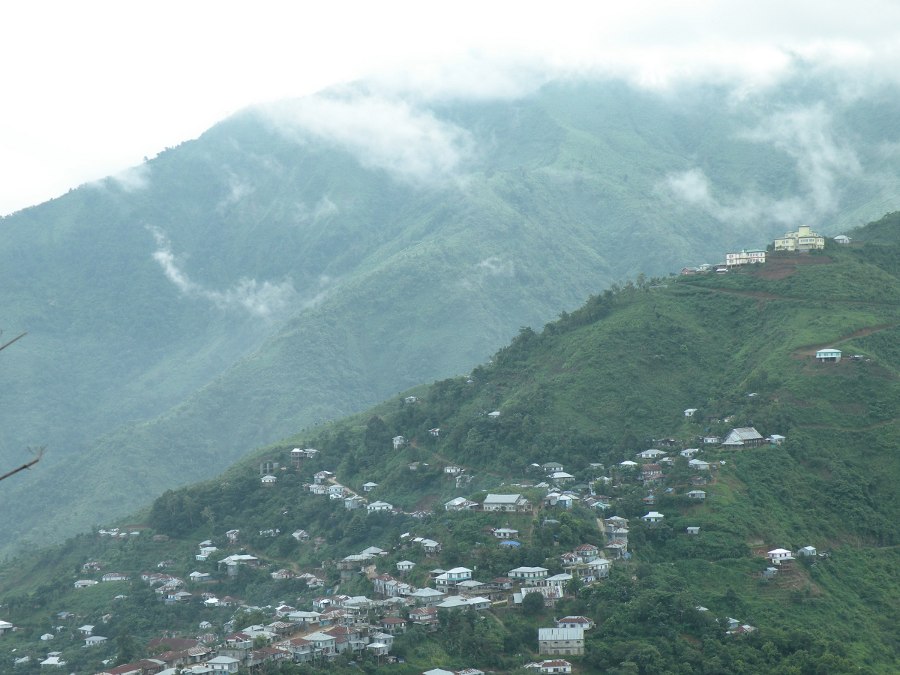
    Saiha, at the southern tip of Mizoram, has offered me many sightings of avian migrants during my three years of working here as the head of the Samrakshan Trust’s conservation education efforts. A sighting of the Common Kestrel Falco tinnunculus was one of my first contributions to the MigrantWatch database last year; and this year too they came back to Saiha to fill my winter months with some memorable sights.

    My first sighting of kestrels in the current season was when we saw two of them take small dives in mid-air, turning (almost!) on their sides and catching insects; this spectacle went on for 15 min. It was fun to see small insects disappear amidst this ‘dance’ of the kestrels; as I write I recall Kipling’s eloquent narrative of the ‘Dance of Elephants’ in his ‘Toomai of the Elephants’. We just sat there at our base-camp and soaked in this sight.

    On later occasions, we have heard their high-pitched calls at about 6 in the morning, as if chastising us for not making an early start to the day.

    One evening at about 4 pm we saw about 20 to 25 Kestrels flying in circles about 30 feet above the ground. There was a fire in the valley and they were presumably enjoying feeding on the insects that fled the fire. It was mesmerising to see the kestrels moving around in joy like children coming out of school. This also led me to look up literature on the Lesser Kestrel Falco naumanni that I thought was a part of that day’s excitement.

    Confusions on raptors has often led me to Rishad Naoroji’s book Birds of Prey of the Indian Sub-continent and here I found some of the day’s observations to be in consonance with his notes on the Lesser Kestrel – “Essentially insectivorous, highly social and flocking species”; “Taking prey (mostly insects) more often on the wing than the Common Kestrel, otherwise hunts similarly but mostly in small groups or large loose flocks, 10 m to 15 m above the ground”; “In Africa catches insects disturbed by grass fires in the air”. Next I checked up the web to confirm calls of the Common Kestrel and Lesser Kestrel. While most of the calls I had noticed belong to the Common Kestrel, the call I had heard today (15 Nov 2010, 1:45pm) was that of the Lesser Kestrel, which has a lower-pitched and harsher voice.

    How exciting to confirm that the rare Lesser Kestrel visits Saiha! It would be wonderful to know where they come from and how long they spend here.

    Some notes on Kestrels from the literature
    About Indian Birds by Salim Ali and Laeeq Futehally ~ ‘There is only one bird which can really remain quite stationary, in the air, even when its wings do not move, and that is the kestrel.’
    A Pocket Guide to the Birds of Mizoram by Anwaruddin Choudhury ~ Common Kestrel is a common winter visitor to Mizoram.

    Relevant Links
    BirdLife International’s summary sheets on Common Kestrel and Lesser Kestrel
    Calls of Common Kestrel and Lesser Kestrel
    MigrantWatch data on Common Kestrel and Lesser Kestrel.

    Nimesh Ved blogs here. He can be contacted at nimesh.ved [at] gmail.com.

  • Take care: we share the air

    Category: ,

    by MigrantWatch Admin

    Watching birds often starts as a relaxing pastime and sometimes progresses into contributing to the science of ornithology. But in Israel, enthusiasts who look for migratory birds go a step further – they save lives.

    Israel’s airspace is stretched to the limit, on the one hand by the national air force, which is one of the world’s biggest and on the other by heavy commercial air traffic. Twice a year, this airspace is also packed with some 500 million migratory birds, which use this narrow bottleneck of land at the junction of Europe, Asia and Africa to move between their winter and summer homes. The bird densities recorded during this period are the highest anywhere in the world.

    This swarm of flying objects – natural and manmade – obviously leads to a high risk of mid-air collisions, accidents and even fatalities. The picture here shows a migrating Common Crane that crashed into a military helicopter in Israel. (Photo from Wikimedia Commons.)

    But a novel initiative by scientists at the Tel Aviv University and the Israeli air force has, over the years, dramatically reduced financial losses and the loss of lives resulting from bird hits. This is achieved through a network of volunteer birdwatchers who provide constant updates over the phone to a central information repository on numbers, altitude and direction of movement of migrating bird flocks. This, combined with radar sensors, satellites, and military drones gives the air force an incredibly detailed picture of bird movements, thereby giving their pilots a chance to plan their own routes accordingly.

    Not surprisingly, pilots quickly learn this motto: “Take care. We share the air.”

    More reading


    Note: In India, airports try to minimise the risk of bird strikes during take-off and landing by habitat management, removal of food sources (for scavenging birds) and by scaring birds away. See this link for some summary information about bird strikes in India.

  • Migration speeds of birds

    Category:

    The speed of migration is different for different species, depending on when they migrate. A new study has found interesting differences in the migration speeds of early and late migrants between Europe and Africa. Do Indian migrants show similar patterns?

    by Raman Kumar

    Raman Kumar is a birder and researcher based in Dehradun who studies human impacts on bird communities. He is currently assessing how woodpecker species in the sal forests of Uttarakhand are affected by different forest management systems. Raman can be contacted at cyornis[at]gmail.com.

    Long-distance migration is a demanding exercise, particularly for small passerine birds that weigh only a few grammes. Flying hundreds to thousands of kilometres – often non-stop – is a great strain. In addition, weary migrants have to contend with predators, rough weather and uncertain stopover conditions along their route. And as if all this were not enough, they also have to reach their destination in time to compete for good wintering or breeding sites.

    Given all these challenges, how quickly should birds attempt to complete their migration? The answer to this depends on the costs and benefits in terms of energy, time, and security. For example, birds often have to make stopovers to feed and replenish their energy reserves before continuing migration. Flying too fast may consume their energy reserves too rapidly, and this could prove fatal. On the other hand, flying slowly might mean a delayed arrival and a consequent risk of better foraging grounds already having been taken over by competitors.

    The speed of migration may also depend on migration distance. Studies have shown that birds that start their autumn journey early fly at greater speeds than those who start later; this may be because early-migrating birds often need to cover larger distances than do late-departing ones that are bound for relatively closer destinations.

    The record for the non-stop long-distance flight is held by the bar-tailed godwit [1]. An individual that was radio-tagged in New Zealand flew 11,000 km to Alaska in a mere eight days, without stopping! Passerines (sometimes called “perching birds”) can travel as much as 300 km in a single day, but their effective speed (including stopovers) over the entire journey is typically 27–75 km per day [2]. Some of them progressively speed up as they move to wintering grounds in the tropics. For most passerines the spring return to breeding areas is traversed much faster (by almost 20–60%) than the autumn migration, possibly due to longer daylight hours or better nutrition along the way.

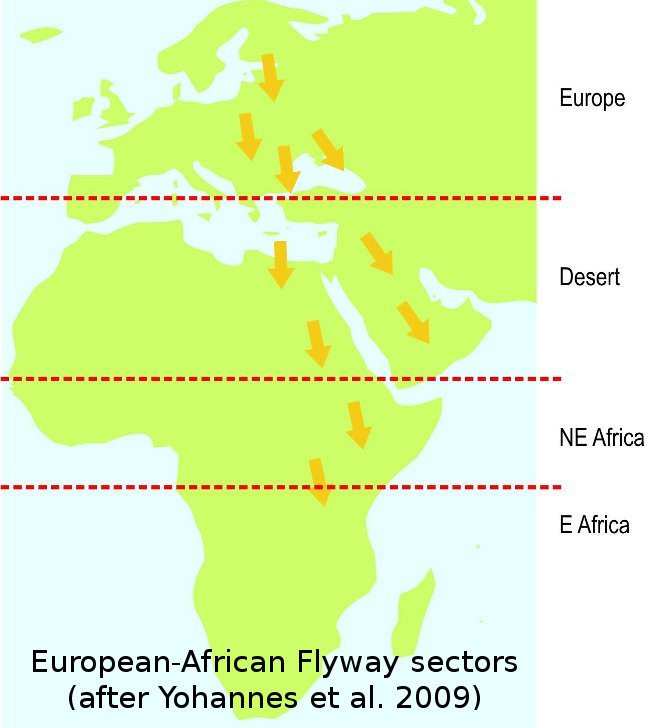
    A recent study [3] has assessed speeds of passerines that migrate long-distance between Europe and eastern Africa. Of the 11 species studied: marsh warbler, sedge warbler, red-backed shrike, thrush nightingale, nightingale, willow warbler, garden warbler, whitethroat, lesser whitethroat, barred warbler, and spotted flycatcher, the last four also visit India during autumn and winter. The route was divided into four latitudinal sectors (Europe, desert, northeast Africa and eastern Africa) [see Map]. Observations from many earlier studies on ringed individuals at various locations along the migratory route were compiled to calculate median dates of arrival or passage for each species.

    The study found that autumn migration speeds in the European sector were higher for those species that started early (e.g. marsh warbler, sedge warbler, nightingale and thrush nightingale). On the other hand, spring migrants in the northeast African sector that started late travelled at higher speeds (e.g. red-backed shrike, marsh warbler, garden warbler and spotted flycatcher). Overall, spring migration time was shorter than that for autumn, mainly on account of relatively faster travel in African and the desert sectors. A speedier spring migration could have evolved due to the competitive advantage for ‘early birds’ who corner better breeding quarters than do latecomers. But there could be another reason for faster travel during springtime. Since days are relatively longer, there is more time available for feeding and hence faster replenishment during the journey.

    The Indian subcontinent, like Africa, is an important destination for millions of wintering birds that come down from northern latitudes beyond the high Himalayas. Yet, information about their arrival and departure timing, speeds and migration routes is scant. Research similar to that conducted on the European-African flyways, but conducted in the subcontinental context, could provide important insights about seasonal movement patterns of passerines in India. Researchers do have a certain idea about the autumn departure dates of some species that also visit India from their breeding grounds in Europe [3,4]: yellow wagtails usually leave Russia in late August, chiffchaffs depart in late August or early September, and lesser whitethroats, bluethroats and white wagtails leave around early September. It would be interesting to observe when these enter India and spread across the subcontinent. The two main ways of generating information on the migration of small birds are intensive bird ringing (and recovery) and large-scale observation networks. Perhaps data from the citizen scientists of MigrantWatch will prompt a better understanding of the fascinating phenomenon of seasonal migration.

    Note from MigrantWatch. If you are interested you can check in the MW database whether the arrival of Yellow Wagtails, Chiffchaffs, Lesser Whitethroats, Bluethroats and White Wagtails in India is related to their departure times from Russia.


    REFERENCES
    [1] Gill, R.E., Jr., Tibbitts, T.L., Douglas, D.C., Handel. C.M., Mulcahy, D.M., et al. 2009. Extreme endurance flights by landbirds crossing the Pacific Ocean: ecological corridor rather than barrier? Proceedings of the Royal Society-B 276: 447-457.

    [2] Newton, I. 2008. The Migration Ecology of Birds. First edition. Academic Press. London.

    [3] Yohannes, E., Biebach, H., Nikolaus, G. and Pearson, D.J. (2009). Migration speeds among eleven species of long-distance migrating passerines across Europe, the desert and eastern Africa. Journal of Avian Biology.

    [4] Ryzhanovskii, V.N. 2008. Dates and duration of the basic seasonal phenomena in the annual life cycle of passerines of the subarctic zone on the example of the lower Ob’ region. Contemporary Problems of Ecology 1:227-237.

  • The Pied Cuckoo in 2010 – Mousumi Dutta

    Category: , , ,

    First arrival of the Pied Cuckoo in 2010 in relation to the onset of the Southwest Monsoon

    by Mousumi Dutta

    Mousumi Dutta is a frequent contributor to the MigrantWatch database. She is an avid birder, and spends her spare time on bird and wildlife conservation. She works with the Indian Meteorological Department, and so has a particular interest in bird migration. Mousumi’s MigrantWatch sightings page is here.

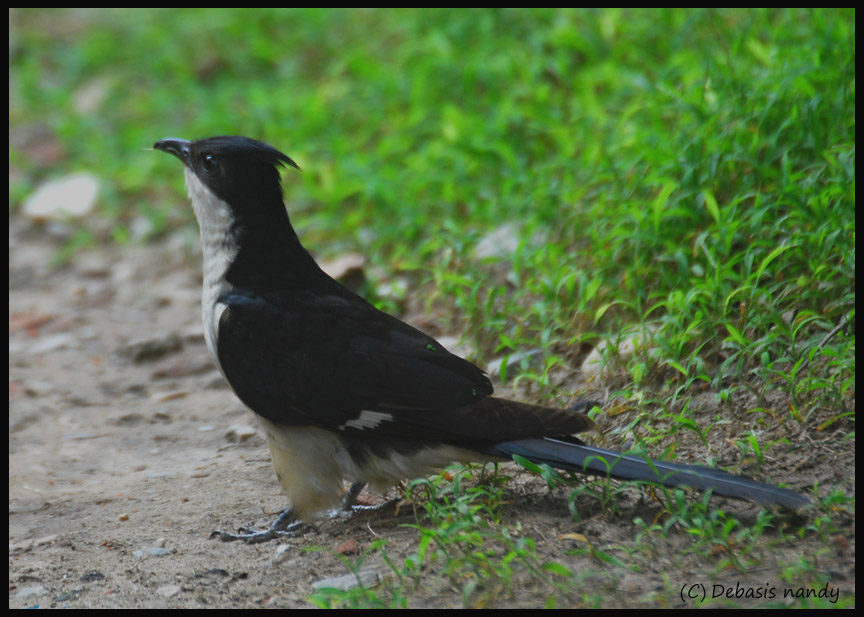
    India’s climate is dominated by monsoons. Most of its annual rainfall (86%) occurs during the Southwest monsoon months. The monsoon is a key influence on agricultural output as well as the overall economic growth of India. From ancient times it has been believed that the onset of the monsoon is associated with the appearance of the Pied Cuckoo Clamator jacobinus.

    The Southwest monsoon normally sets in over Southeast Bay of Bengal on 20 May and then over Kerala on 1 June. An analysis of the first sighting dates of the Pied Cuckoo and the onset of the Southwest monsoon for the year 2010 (see figure below) shows a fairly systematic pattern. In general, the first sighting of this species in a State is 20-25 days in advance of the onset of the monsoon in that State. This appears to be earlier, relative to the monsoon, than reported for last year.

    These patterns indicate an interesting relation between the onset of the monsoon and the arrival of Pied Cuckoos. Long term studies are needed to clarify the details of the relationship between the monsoon winds and Pied Cuckoo migration.

    Methods
    First sighting dates (after January 2010) for Pied Cuckoos for each State were taken from the MigrantWatch database. (Maharashtra and the four southern States were excluded.) Dates of the onset of the monsoon for each State are taken from the Indian Meteorological Department’s monsoon pages (click on “Northern Limits of Monsoon”). The data used to generate the figure are given below. The links under “Reported by” point to the sighting page on MigrantWatch.

    State First Sighting Onset of Monsoon Reported by
    Orissa 16 May 13 June Aditya Panda
    West Bengal 17 May 14 June Supriyo Ghatak
    Gujarat 30 May 16 June Nandita Amin
    Madhya Pradesh 10 June 4 July Anand Kumar Bhatt
    Uttarakhand 27 May 5 July Sharad Khanna
    Chandigarh 6 June 5 July Vikram Jit Singh
    Delhi, including NOIDA 31 May 5 July KB Singh, email to MigrantWatch
    Haryana 22 June 5 July Vikram Jit Singh
    Himachal Pradesh 29 June 5 July Devinder Singh Dhadwal
    Rajasthan 24 May 6 July Saandip Nandagudi


    If you would like to make your own visualisation and analysis of Pied Cuckoo sightings, you can download all 300+ records here. Please share your findings with everyone at MigrantWatch – send us (mw@migrantwatch.in) a small blog post and we will put it up.

  • A guide to the website

    Category:

    MigrantWatch has an all-new look. Here is a tour of the site, with explanations, tips and tricks for key pages and activities.

    1. Registering
    2. Exploring data
    3. Contributing data
    4. Uploading photos
    5. Supporting the community
    6. Fun things to do

    1. Registering

    The signup link enables you to set up a personal account with MigrantWatch. You’ll need this account if you want to upload sightings and accompanyingmw-register1 photos; download data to import into Google Earth or Excel; or comment on sightings and photos of others. We ask for your full name, and not a login name, because a scientific project like MigrantWatch needs each uploaded piece of information to be associated with an identifiable person. Please check first whether you are already registered by looking at the participants page. Although you are not required to provide your mobile number, please consider doing so, as we plan to soon implement a system by which you can interact with MigrantWatch over your phone.

    2. Exploring data

    All data collected under MigrantWatch is free for you to search and explore, and even to download, analyse and publish the results of your explorations. When using the data, please note that although we have tried to ensure data accuracy, we cannot guarantee that the database is free from errors.

    • Searching tips. When performing data searches, you can choose from a variety of filters – by Species, Location, State, Year, Sighting type, Participant; or any combination of these. The URL in the address bar of your browser changes when you press “go”, so if you want to run the same search in the future, simply bookmark that URL and come back to it later. You can also add your frequent searches to your watchlist.mw-searchscreen
      mw-mapiconsOn the displayed map, locations of sightings are grouped into circles, with the number on the circle specifying the number of unique locations that match your search. The position of these circles is very approximate. As you zoom in, individual locations will begin to be displayed, whose position is accurate. You can click on the icon associated with an individual location to see details of the records at that location. Anyone can search the MigrantWatch database – you don’t have to be registered and logged in.
    • Downloading tips. Results of searches can be downloaded in two formats – KML and CSV. Both are plain-text files. KML files can be imported into geographic software like Google Earth and displayed there. CSV files have data fields separated by commas, and can be imported into spreadsheet software like Excel or OpenOffice for further analysis. mw-downloadThis file contains all the basic information about the records that match your search and should allow you to carry out your own analyses. Some information (like users’ email addresses) is excluded from this file to protect participant privacy. Please note that you must be registered and logged in to be able to download raw data.
    • Data interpretation. Although a large number of records in MigrantWatch are tagged as either First or Last sightings, please note that whether a particular record represents the first arrival of the species in an area depends on a variety of things, including the date since when the observer has been looking for migrants at that location, and how frequently he or she does so. Also, records marked as “General” may well represent the first or last reports of a species from a location. Please keep this in mind while exploring the database.

    3. Contributing data

    If you are registered with MigrantWatch we hope you will contribute to the community of participating volunteers by uploading your sightings of migrant birds. While MigrantWatch focusses on collecting information on First and Last sightings of migrants in a season, observations in the middle of the season can be added as General sightings. We define a season, based on winter Palaearctic migrants, as lasting from 1 July of one year to 30 June of the next.

    • Reporting sightings. Once you log in to your account, you will see a new set of links on the top right of the webpage. Among these are links to report sightings and edit sightings. Clicking on report sightings takes you to a form through which you can add your migrant sightings. Most of the fields in this form are self-explanatory. mw-locnotfoundPlease decide whether your sighting(s) are the First of the season, the Last of the season, or General sightings in between. When specifying the location of your sighting, please use the search box to see whether that location already exists in the database. Only if it does not exist, use the “add a new location” link.
    • Adding a new location. We now have a map-based interface for users to add information about a new location. This is because one of the most crucial pieces of information about a site is its geographic position. There are two ways in which you can specify the position of your new location. One is to use the search box. mw-addlocationFor example, type in “Botanical Gardens, Kolkata” and then click on Search. If the software finds a match, it will zoom in to that location. Please take a minute to check whether that is the location you intended, and whether the location Name, City and State were correctly filled in automatically. You can always make corrections by clicking directly on the map and by editing the text boxes. The second way is to bypass the search box entirely and simply zoom and click on the map. This is particularly useful if the Search gives the error “unable to geocode that address”. You can, of course, use a combination of search and click — for example to search for Bhopal, and then look manually for the IIFM campus. Specifying the geographical coordinates of your location is crucial, and we request that this be done with some care!
    • Finishing up with reporting your sightings.Once you have chosen an existing location or added a new one, you can then continue with the rest of the form. The information on particular species is entered in a series of boxes at the bottom of the form. If you want to submit information on more than one species at that location and of that sighting type (First/Last/General), you can click on “Add another species” and a fresh row of text boxes will appear. Once you’ve finished, click on “Submit your sighting”, and you will be taken to a page that summarises the information you have just contributed, and gives you the option to upload photos to accompany your sightings.

    4. Uploading photos

    You can upload photos to accompany your sighting either at the time you submit your sighting information, or at any time after that, by going to edit sightings. Photos should be of the species you are reporting. At the moment, we can’t accept photos of general habitat, landscapes, and so on. Each photo will be tagged with the sighting details you have given for that bird. You can upload up to four photos to accompany each sighting. Uploading photos has multiple uses. They can be used to corroborate species identification; to examine plumage variation across time or space; and simply to share your photos with your friends and the larger MigrantWatch community. Photos need not be of high quality to suit these purposes!

    5. Supporting the community

    • Comment on sightings/photos. A new feature on our website is that each site has a unique page, and so has each photo uploaded. We have also enabled comments, so that anyone logged in can comment on each others’ sightings and photos.
    • Check location correctness. Just like sightings, and photos, each location also has its own unique page, and by clicking on it you can see various details about that location including its geographical coordinates, if we have them. If you think there is an error in the geographical coordinates of a location, do drop us an email at mw@migrantwatch.in. We will soon have a facility for users to provide comments on individual locations, including suggesting corrections.
    • Help ensure data accuracy. In general, we would be grateful if you can help ensure data accuracy by verifying the information that you upload, and by adding a comment or otherwise informing us if you have reason to doubt the accuracy of any piece of information on MigrantWatch, including species identity, sighting dates and geographical coordinates of locations.

    6. Fun things to do

    Although MigrantWatch has a serious purpose, which is to document migration timing and monitor whether this is changing as the climate is changing, we hope that you will also enjoy various aspects of participating!

    • Share photos. Photos are a great way to tell others of your sightings — and comments allow a conversation to grow around them.
    • Share experiences. There are various ways to tell others more about your migrant sightings. One is as comments on your own photos. But if you would like to share a longer experience, perhaps with some background material on the species you saw or the location, you could potentially contribute a piece to the MigrantWatch blog. If you have ideas for such a piece, please do contact us.
    • Explore migration information. The website contains various resources on birds, migration, and citizen science. There is also a species guide for the 15 highlighted migrants covered by MigrantWatch. If you come across other resources or information that should be added here, we’d love to hear from you!

    Happy migrantwatching!