
MigrantWatch

MigrantWatch archive (2007–2015)
Report migrant sightings on eBird India · about this archive

Cranes flying against an orange sky
  • Leaf warbler ID made easy! Part III: Tips on identification

    By Mousumi Ghosh (with inputs from Umesh Srinivasan)

    Tips for Identification

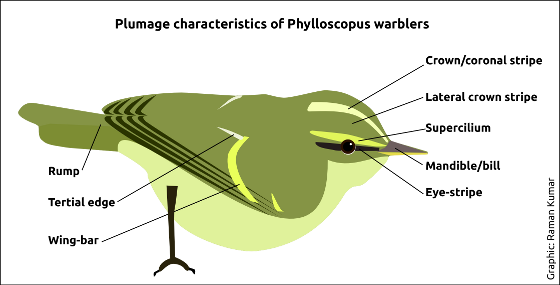
    If you’re keen to start leaf warbler watching, you just need an ear for it! You can start with the commonly encountered leaf warbler species in our backyard like Hume’s Warbler (in North India) and Greenish Warbler (in South India) and fortunately, both are extremely vocal. Anytime I want to hear a Hume’s Warbler in winter here in Dehradun, I just have to strain my ears a bit and sure enough I can hear one (yes, it’s that common during winter in North India). Both are territorial in winter and call incessantly guarding their precious trees from the canopy. So, let’s get acquainted with some of the commoner species which visit us in the plains in winter (Here is an illustration to help you with some of the terms commonly used while describing warblers):
    phylloscopus schematic_lite

    Humes warbler - Raman DSC05060 cropped 1Hume’s Warbler (Phylloscopus humei):  One of the commonest leaf warblers, it has an overall dull colour with greenish upperparts and off-white underparts. Other features include a long supercilium, weak/absent crown-stripe, prominently pale tertial edges, no white margins to the tail, one prominent pale wing bar (just a faint vestige of the second wing bar may be visible). The darker legs and lower mandibles are diagnostic. Hume’s is among the smaller of leaf warblers; it breeds near the tree-line and is partial to birch forests in the summer. In the winter it is one of the commonest species found all over the plains of North India. It’s solitary in winter and calls incessantly from the crowns of trees. Call: A repeated, disyllabic ringing tiss-yip, buzzy wheezing tzzzeeeeeu, often given interspersed with calls.
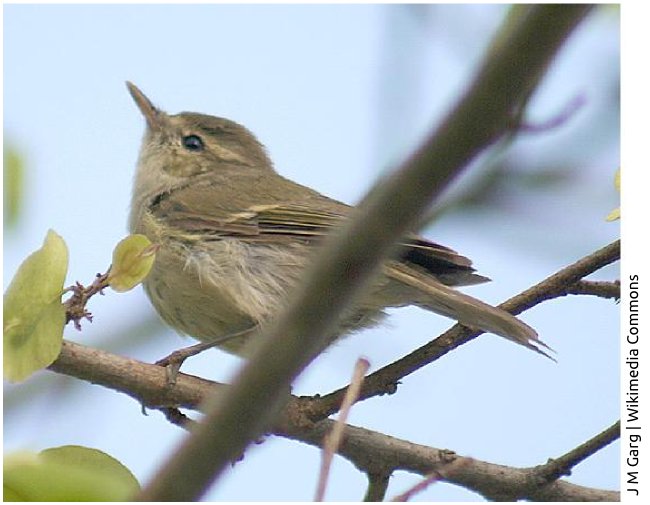
    Greenish_Warbler_I_IMG_0570_JM Garg cropped 1Greenish Warbler (Phylloscopus trochiloides): A common winter migrant in peninsular India, it is one of the larger leaf warblers. It has greyish-green upper parts and off-white underparts. Absence of coronal stripe, yellowish-white supercilium and a single wing bar are other features which help distinguish this species.

    During the breeding season, Greenish Warbler occurs close to the tree-line in mixed-conifer forests and rhododendrons. In winter, it is territorial and partial to the canopy, from the top of which it calls incessantly to defend its precious territory. Call:  a disyllabic tisswit or chiswee.

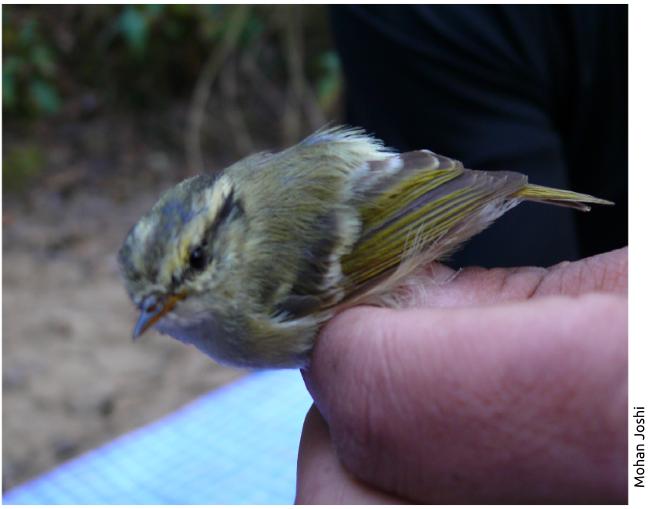
    Lemon-rumped Warbler (Phylloscopus chloronotus): This tiny little leaf warbler gets its name from its pale yellowish rump which is frequently exposed as it hovers at the edge of leaves to pick arthropod prey. It’s a rather active bird with olive lemon-rumped warbler_P1120734_Mohan Joshigreen upperparts, whitish underparts, dark bill and pale legs. The head is rather distinctive with a prominent pale yellow crown stripe, a broad yellowish supercilium and a very dark eye-stripe which broadens behind the eye and hooks under the ear coverts. Typically two yellowish wing bars are visible, the lower one being larger and more prominent. This species is an altitudinal migrant, spending the summer in the mixed coniferous, oak and rhododendron forests and retreating to the foothills in winter where it joins mixed-species flocks to forage mostly in the mid-canopy and undergrowth. More than two may be part of the same flock, daintily hovering around the vegetation and is an absolute treat to watch! Call: A high-pitched tsip or uist.
    Apart from the above there are a number of other species of Phylloscopus warbler that can be observed in the Indian subcontinent. Most of these species migrate over long distances to winter in the Indian plains and peninsular India, some show an altitudinal migration, and a couple of them are resident throughout the year. Here is a very handy key for their visual identification compiled by Umesh Srinivasan.
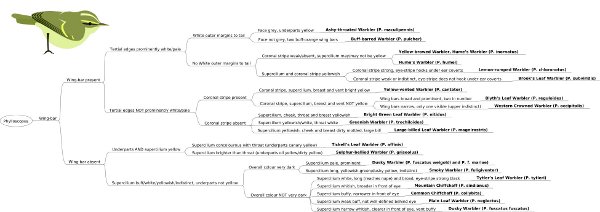
    Phylloscopus key 1

    This concludes our three-part series on Phylloscopus warblers. We hope that these articles helped you in identifying the main species in this difficult group and also provided interesting information about the ecology of leaf warblers. We’d like to know if you liked this series and if you’d like us to run more such articles in the future on the MigrantWatch blog. Please do send in your comments and feedback at mw@migrantwatch.in. 

    You can read Part I and Part II in this series of articles on leaf warblers.
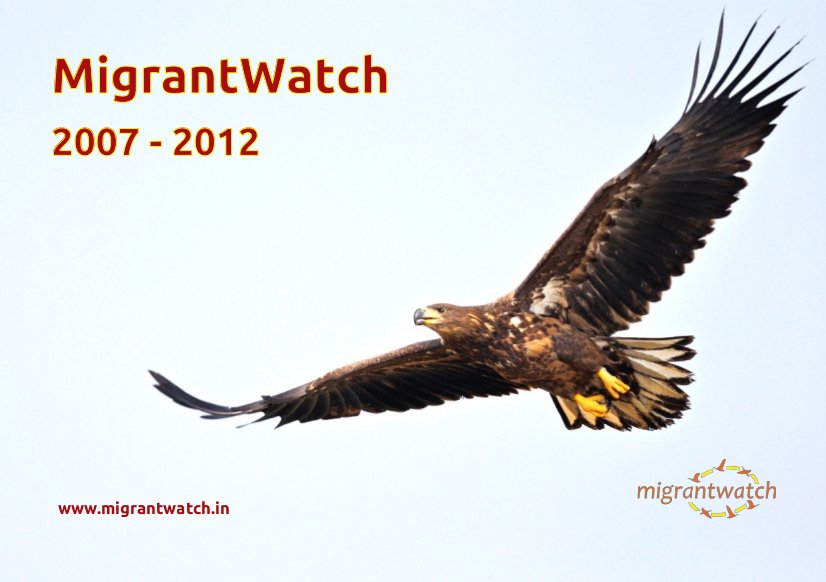
  • MigrantWatch: A five-year journey

    Since 2007 MigrantWatch has brought together hundreds of birders across India to pool their observations of migratory birds. Over the years, our enthusiastic participants have collectively contributed more than 20,000 records of nearly 250 bird species. The idea of collecting all this information in one place is to document patterns of bird migration in the Indian subcontinent.

    To mark the completion of 5 years of MigrantWatch, we have put together a brief summary of the migration patterns that are emerging. We hope you will enjoy it, and will tell your other birding friends about it too.

    You can download a soft copy of the summary here [PDF, 2.9 MB; right-click to save it]. We have also printed a set of copies, and if you would like a hardcopy of the summary, just mail your postal address to us at mw@migrantwatch.in, and we will be happy to send you a copy.

    A big ‘Thank You!’ to all participants and contributors, and we look forward to working with you for the next five years!

    MigrantWatch 5-years summary report 2013-03-cover

  • MW round-up: February 2013

    Category:

    The February 2013 issue of the monthly round-up of the latest news at MigrantWatch has been sent to all participants. If you are registered with us, but haven’t received this email, please check your spam folder; and add mw@migrantwatch.in to your address book. Do send us a message if you have any questions.

  • Dewar’s Calendar — March

    Category:

    Here we present the next extract from Douglas Dewar’s A Bird Calendar for Northern India, published in 1916, where the author gives a wonderful account for the month of March, with particular reference to bird migration.

    In March the climate of the plains…varies from place to place. In the western sub-Himalayan tracts, as in the Punjab, the weather still leaves little to be desired. The sun indeed is powerful…but the nights and early mornings are delightfully cool.The garden, the jungle and the forest are beautified by the gorgeous reds of the flowers of the silk-cotton tree, the Indian coral tree and the flame-of-the-forest.March is a month of great activity for the birds…The great exodus of the winter visitors from the plains of India begins…

    This exodus is usually preceded by the gathering into flocks of the rose-coloured starlings*… Large noisy congregations of these birds are a striking feature of February in Bombay, of March in the United Provinces, and of April in the Punjab.

    Rose-coloured starlings spend most of their lives in the plains of India, going to Asia Minor for a few months each summer for nesting purposes. In the autumn they spread themselves over the greater part of Hindustan, most abundantly in the Deccan.

    In the third or fourth week of February the rosy starlings of Bombay begin to form flocks. These make merry among the flowers of the coral tree, which appear first in South India, and last in the Punjab. The noisy flocks journey northwards in a leisurely manner, timing their arrival at each place simultaneously with the flowering of the coral trees. They feed on the nectar provided by these flowers and those of the silk-cotton tree. Thus the rosy starlings reach Allahabad about the second week in March, and Lahore some fifteen days later.

    Among the earliest of the birds to forsake the plains of Hindustan are the grey-lag goose and the pintail duck… The destination of the majority of these migrants is Tibet or Siberia, but a few are satisfied with the cool slopes of the Himalayas as a summer resort in which to busy themselves with the sweet cares of nesting… Examples of these more local migrants are the grey-headed and the verditer flycatchers, the Indian bush-chat and, to some extent, the paradise flycatcher and the Indian oriole.

    The Indian oriole is not the only species which finds the climate of the United Provinces too severe for it in winter; the koel and the paradise flycatcher likewise desert us in the coldest months…The return of these and the other migrant species to the Punjab in March is as marked a phenomenon as is the arrival of the swallow and the cuckoo in England in spring.

    * Current name: Rosy Starling.

    Taken, with grateful thanks, from Project Gutenberg.

  • Events: Great Backyard Bird Count and Big Bird Day

    Category: , , ,

    More than 200 birders from all across India participated in the Great Backyard Bird Count held between 15th and 18th February. This year’s event (which until last year had been largely a North American affair) was conducted globally for the first time. Indian birdwatchers put up a wonderful show. A summary of the first Indian edition of the Great Backyard Bird Count can be viewed here.

    Another event – the Big Bird Day – was celebrated on 24th February. Coordinated by Delhibird, more than 300 individuals and teams birded at various locations across India and recorded all birds they could see on that Sunday. More details are available here.

  • Barn Swallow over 5 years

    Continuing our presentation of year-wise arrival patterns, here we show the results for Barn Swallow.

    Please note that each sighting is shown as a vertical black line.

    Barn Swallow by year

    From the above illustration it is evident that Barn Swallows usually arrive around late July/early August and nearly all of them leave by April.

    You can explore the Barn Swallow sightings on MigrantWatch here.

  • Participant Profile: Dipu Sasi

    Category:

    Dipu Sasi

    Where do you live?
    I hail from Kumarakom (Kerala) which is part of the Vembanad Kol Wetland, an Important Bird Area. But for the past four years I am in in Kanha National Park (Madhya Pradesh) where I work as a naturalist with Taj Safaris who operate a lodge there.

    When did you start watching birds?
    I developed an interest in bird watching in my early teens. It all started with me joining a conservation NGO. I took some field study and conservation lessons with them, including some birding trips with seasoned birders. That got me interested in the wonderful world of birds.

    Who would you consider your birding mentor?
    I have had the opportunity to bird with some brilliant experts. These have ranged from field scientists to guides from local communities who have lived all their lives in the jungle and know the intricate details of bird habits which cannot be found in books. However, I hold Dr. B Sreekumar – a renowned birder form Kerala – as my guru in this field. For the last decade I have been fortunate to be involved in most of the bird counts conducted by the Forest Department and other organisations in Kerala, which helped me hone my skills as a birder.

    Please describe a memorable birding experience.
    Any time I go to a new habitat where the birdlife is very different is memorable for me. However, If I had to choose one, it would be my first trip to Corbett National Park. I saw an astounding number of new birds, one which we so lovingly call ‘lifers’. Nearly 180 ‘lifers’ in a few days was one of my most memorable birding experiences.

    What are your favourite migrants?
    It would have to be the various warblers and waders. It has always thrilled me to hear their calls, especially of waders in Kerala where they migrate in large numbers.

    What is your favourite place to watch migrants?
    Rann of Kutch in Gujarat, and the large wetlands of Southern India. The species found at these places are so vastly different from each other.

    Do you have any advice for beginning birdwatchers and naturalists?
    Enjoy the birds to begin with, before getting into a competition mode of chalking up numbers.

    Why do you think people should care about birds and nature?
    By taking care of birds and nature you are only taking care of yourself and the generations to come.

    Any other information that you’d like to share with MigrantWatchers?
    Apart from birding, I am very concerned about the usage of plastic in our everyday lives. I endeavour and am working towards awareness against the use of this menace that is, along with other pollutants destroying our planet. It is time to start acting locally, and I beseech each one reading this, to stop the use of plastic starting with yourself and your family. Thank you!

    You can see Dipu Sasi’s MigrantWatch contributions here.

  • 20,000th record on MigrantWatch!

    Category: , ,

    We reached another milestone on MigrantWatch with Dr. Jayant Wadatkar’s sighting of Garganey at Wadali Tank, near Amravati, Maharashtra, on 10 February, 2013. Dr. Wadatkar sighted eight migrants (including Garganey) during this visit. This was the 20,000th record to be uploaded on MigrantWatch. By strange coincidence the 10,000th, 15,000th and 20,000th sightings have all come from Amravati, Maharashtra, while 15,000th and 20,000th sightings have been reported by the same person – Dr. Jayant Wadatkar!

    Congratulations to all MigrantWatchers who helped in reaching this landmark!

  • MW round-up: January 2013

    Category:

    The January 2013 issue of the monthly round-up of the latest news at MigrantWatch has been sent to all participants. If you are registered with us, but haven’t received this email, please check your spam folder; and add mw@migrantwatch.in to your address book. Do send us a message if you have any questions.

  • Greenish Warblers over 5 years

    Category: , ,

    Here we present the year-wise arrival pattern of one of our most observed species – the Greenish Warbler.

    As in our earlier illustrations, each sighting is shown as a vertical black line.

    Greenish Warbler by year

    The above graphic shows that Greenish Warblers start their southward migration into the Indian subcontinent in late August. They stay on till early summer and by May almost all of them return to their breeding grounds in the Himalayas and beyond.

    To look at all the Greenish Warbler sightings on MigrantWatch please click here. You may also want to look at our series on Phylloscopus warblers here.