MigrantWatch

MigrantWatch archive (2007–2015)
Report migrant sightings on eBird India · about this archive

Cranes flying against an orange sky
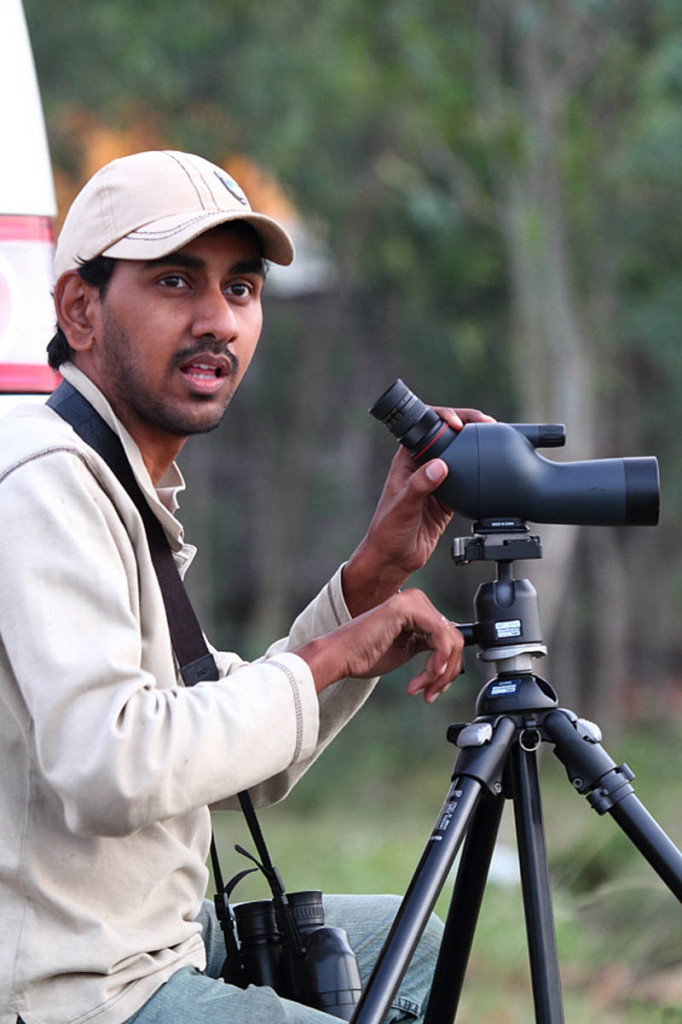
  • Participant Profile: Shyamkumar Puravankara

    Category:

    shyamkumarp

    Where do you live?
    I live in Peralam, Pullur Periya panchayath, near Kanhangad town in Kasaragod district of Kerala.

    When did you start watching birds?
    I began watching birds from my childhood but took up birding as a serious hobby since 2006 when I was in my final year studying architecture.

    Who would you consider your birding mentor?
    Two people – Varun Thangamoni and Anuradha Sarang – were my mentors in birdwatching.

    Please describe a memorable birding experience.
    I, along with members of our Environment Club, had gone to meet Mr Kareem (also known as Parappa), who has converted a barren piece of land into a forest in Kasaragod. While birding there we saw an adult male Paradise Flycatcher (nakamohan in Malayalam). It was catching insects with swift movements, like an artist who paints an abstract art. Such a moment is the best a birder can have. That sighting of Paradise Flycatcher inspired me into becoming a regular birder.

    What are your favourite migrants?
    Indian Pitta (Pitta brachyura) and Asian Paradise Flycatcher (Terpsiphone paradisi) are my favourite migrant birds.

    What is your favourite place to watch migrants?
    Chemmattamvayal (near District Hospital, Kanhangad) is my favourite site to watch migrants.

    Do you have any advice for beginning birdwatchers and naturalists?
    Love Nature, which you are part of. Only then you will have a meaningful existence.

    Why do you think people should care about birds and nature?
    Birds can live without humans, but humans will perish without birds.

    You can see Shyamkumar’s MigrantWatch contributions here, and his photos here.

  • Dewar’s Calendar – February

    Category:

    Continuing with the series of extracts from Douglas Dewar’s A Bird Calendar for Northern India, published in 1916, here is his lyrical description for February.

    February is the most pleasant month of the whole year… The climate is perfect. The nights and early mornings are cool and invigorating; the remainder of each day is pleasantly warm… The Indian countryside is now good to look upon; it possesses all the beauties of the landscape of July; save the sunsets.

    Towards the end of the month the silk-cotton trees begin to put forth their great red flowers…

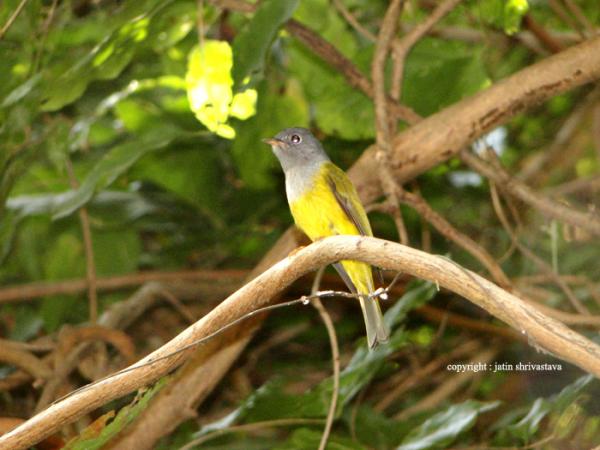
    The fowls of the air are more vivacious than they were in January… The coppersmiths…begin to hammer on their anvils. As in January so in February the joyous “Think of me … Never to be” of the grey-headed flycatcher* (Culicicapa ceylonensis) emanates from every tope…The large grey shrikes add the clamour of their courtship to the avian chorus.

    Courtship is the order of the day…

    …the white-browed fantail flycatchers begin to nest. The loud and cheerful song of this little feathered exquisite is…one of the most familiar of the sounds that gladden the Indian countryside.

    * Current name: Grey-headed Canary Flycatcher.

    Taken, with grateful thanks, from Project Gutenberg.

    Below is a photo of a Grey-Headed Canary Flycatcher taken by MigrantWatcher Jatin Shrivastava near Jalgaon, Maharashtra.

  • December round-up

    Category: ,

    The December 2012 issue of the monthly round-up of the latest news at MigrantWatch has been sent to all participants. If you are registered with us, but haven’t received this email, please check your spam folder; and add mw@migrantwatch.in to your address book. Do send us a message if you have any questions.

  • Arrival pattern for the Rosy Starling

    Category: , , ,

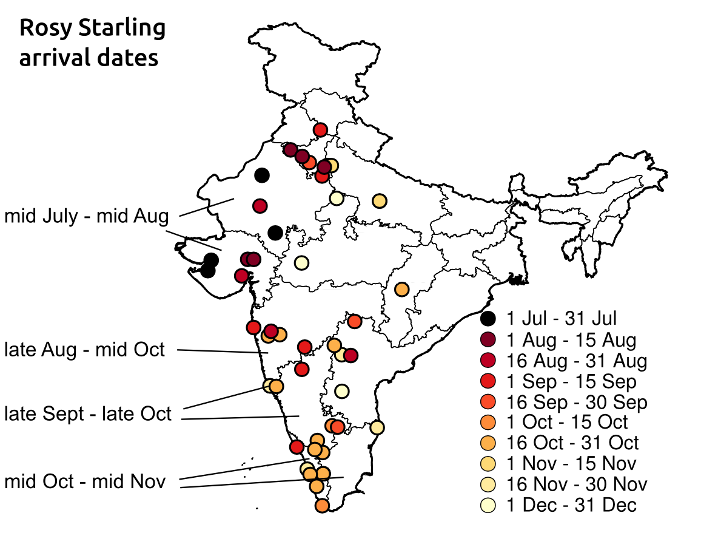
    In this post we share with you the arrival patterns of Rosy Starling as it moves across the country. As is evident in the illustration below, Rosy Starlings arrive early (around mid to end July) in northwestern India, but then take three to four months to trickle down to the southernmost States!

    RosyStarlingMap-noBG

    You can look at all Rosy Starling sightings in the MigrantWatch database here. Many thanks for all who contributed their observations.

    Note on how this map was made: you might wonder why, given there are many hundred Rosy Starling records in the database, there are so few points shown here. In each migration season (July to June; five migration seasons in all) we took the earliest sighting for each State; and these State-wise early sightings are depicted here. So, to reiterate, the points shown on the map are the earliest sightings for each State. Multiple  points within a State represent different migration seasons. The labels on the left describe the typical pattern for a given State or region, taking all migration seasons into consideration. You can download the State-wise first sightings in an Excel file here.

  • Dewar’s Calendar – January

    Category: ,

    Continuing with the series of extracts from Douglas Dewar’s A Bird Calendar for Northern India, published in 1916, here is his lyrical description for January.

    Take nine-and-twenty sunny, bracing English May days, steal from March as many still, starry nights, to these add two rainy mornings and evenings, and the product will resemble a typical Indian January. This is the coolest month in the year, a month when the climate is invigorating and the sunshine temperate…

    January is the month in which the avian population attains its maximum. Geese, ducks, teal, pelicans, cormorants, snake-birds and ospreys abound in the rivers and jhils; the marshes and swamps are the resort of millions of snipe and other waders; the fields and groves swarm with flycatchers, chats, starlings, warblers, finches, birds of prey and the other migrants which in winter visit the plains from the Himalayas and the country beyond…

    From every mango tope emanates a loud “Think of me … Never to be.” This is the call of the grey-headed flycatcher* (Culicicapa ceylonensis), a bird that visits the plains of northern India every winter. In summer it retires to the Himalayas for nesting purposes…

    The nuthatches begin to tune up in January. They sing with more cheer than harmony, their love-song being a sharp penetrating tee-tee-tee-tee-tee.

    * Current name: Grey-headed Canary Flycatcher.

    Taken, with grateful thanks, from Project Gutenberg.

  • Participant Profile: Gnanaskandan Kesava Bharathi

    Category:

    gnanskandan k-edited-new

    Where do you live?
    I live in the city of Chennai.

    When did you start watching birds?
    I was very much interested in mammals and birds right from my childhood. Teaming with my brother, I took birdwatching as a hobby in 2002 at my hometown Thiruvannamalai. With Birds of Rishi Valley being our first field guide, the first bird we spotted was the Common Hoopoe. This kick-started my interest in birding. After moving to Chennai, joining the Madras Naturalists’ Society in 2008 took my birding to a higher level.

    Who would you consider your birding mentor?
    Well, the list is very long. I learnt from every birder I met and consider each one as my mentor. Prof. A. Chandrasekaran introduced me to the birds of Chennai. Through constant guidance from experienced birders such as Dr V. Santharam, Dr A. Rajaram and P. Ramanan, I gained a lot of birding gyan, and improved my bird identification skills. Also, my friend T. Varun’s on-the-field mentoring helped me understand bird behaviour and enhanced my interest in raptors.

    Please describe a memorable birding experience.
    The sighting of Red-necked Falcons near Siruthavur Lake, Chennai, in 2010 is the most memorable one. As distribution maps didn’t show any records of this species from the east coast of Tamil Nadu, my entire birding gang visited Bangalore in search of the Red-necks but our search ended in vain. Weeks later, we went on birding around the Siruthavur Lake which is one of our favourite birding haunts. We spotted a small raptor perching on an electric pole, which at first glance looked like a Black-shouldered Kite. As we raised our binoculars, it turned out to be a Red-necked Falcon – the bird that had been eluding us for so long!

    What are your favourite migrants?
    Even though I am a “raptorphile”, waders are my favourite migrants, as they always pose a great challenge in identification. My favourites are the Sanderling, Ruddy Turnstone and Terek Sandpiper. Apart from these, harriers and falcons have always inspired me with their flights and are on top of my list.

    What is your favourite place to watch migrants?
    Pulicat is one of my favourite migrant watching grounds. Areas in and around Pulicat show diverse habitats – open grasslands for harriers and storks, thick scrub that support kestrels and warblers, shallow water lakes housing hundreds and thousands of waterfowl, waders and flamingos; and exposed mud-banks that have gulls and terns. Kelambakkam salt pans are yet another favourite for waterbirds and Peregrine Falcons.

    Do you have any advice for beginning birdwatchers and naturalists?
    Most beginners and even experienced birders tend to ignore watching challenging groups like waders, larks, pipits and warblers, which should not be the case. Beginners should understand, follow and encourage others to follow the basic birding ethics. Also, people should involve themselves in any form of data collection process and even a small observation will add importance to bird research in the long run.

    Why do you think people should care about birds and nature?
    Birds are good indicators of a healthy environment. We can also understand the effects of climate change from them. They provide vital ecological services such as pollination, scavenging, seed dispersal and keeping insect populations under control. They are integral part of our ecosystem and without them, humans will perish.

    You can see Gnanaskandan’s MigrantWatch contributions here, and his photos here.

  • November round-up

    Category: , , ,

    The November issue of monthly round-up of the latest at MigrantWatch has been sent to all participants. If you are registered with us, but haven’t received this email, please check your spam folder; and add mw@migrantwatch.in to your address book. Do send us a message if you have any questions.

  • Grey Wagtails over 5 years

    Category: , , ,

    As we compile the MigrantWatch 5-year report we are looking at migration timings of various species. Here we present a visual summary for Grey Wagtail over the five years of data collection.

    Each sighting is indicated with a vertical black line, just as in this image of sightings of several species.


    It is apparent that most Grey Wagtails arrive in September, although their arrival begins in August itself. The earliest record of the season was by Urmila Ganguli on 1st August 2007. Most of them leave by April. Although the chart shows a couple of sightings in June, both these observations are actually from Himalayan areas where the Grey Wagtails likely breed.

    To look at all Grey Wagtail sightings in the MigrantWatch database please click here.

  • Dewar’s Calendar – December

    Category: ,

    We bring to you the second in the series of extracts from Douglas Dewar’s A Bird Calendar for Northern India, published in 1916. This is what Dewar writes for December.

    December, like November, although climatically very pleasant, is a month in which the activities of the feathered folk are at a comparatively low ebb. The cold, however, sends to India thousands of immigrants. Most of these spend the whole winter in the plains of India. Of such are the redstart, the grey-headed flycatcher, the snipe and the majority of the game birds. Besides these regular migrants there are many species which spend a few days or weeks in the plains, leaving the Himalayas when the weather there becomes very inclement. Thus the ornithologist in the plains of Northern India lives in a state of expectancy from November to January. Every time he walks in the fields he hopes to see some uncommon winter visitor. It may be a small-billed mountain thrush [1], a blue rock-thrush, a wall-creeper, a black bulbul, a flycatcher-warbler [2], a green-backed tit, a verditer flycatcher, a black-throated [3] or a grey-winged ouzel [4], a dark-grey bush-chat [5], a pine-bunting, a Himalayan whistling thrush [6], or even a white-capped redstart. Indeed, there is scarcely a species which inhabits the lower ranges of the Himalayas that may not be driven to the plains by a heavy fall of snow on the mountains. Naturally it is in the districts nearest the hills that most of these rare birds are seen—but there is no part of Northern India in which they may not occur.

    Current names: [1] Scaly Thrush; [2] Grey-hooded Warbler; [3] Dark-throated Thrush; [4] Grey-winged Blackbird; [5] Grey Bushchat; [6] Blue Whistling Thrush.

    Taken, with grateful thanks, from Project Gutenberg.

  • More about Amur Falcons in Nagaland

    Category: , ,

    MigrantWatcher Nimesh Ved recently visited Nagaland and attempted to find out more about the mass hunting of Amur Falcons. For an update on this trip please visit Nimesh’s blog.

    See related MW blog post here.