
MigrantWatch

MigrantWatch archive (2007–2015)
Report migrant sightings on eBird India · about this archive

Cranes flying against an orange sky
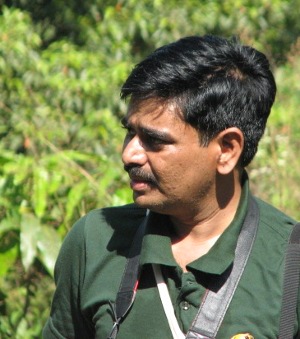
  • Participant Profile: Prathamesh Desai

    Category:


    Where do you live?
    I live in Dombivli, a small city in Thane district of Maharashtra.

    When did you start watching birds?
    My interest in birds began in primary school when my parents got me a book called ‘My Album of Birds’, which was a basic introduction to birds from around the world. That’s when I discovered that there were birds like hornbills, toucans and storks, and not just sparrows or pigeons as depicted in childhood stories. But my real journey into birding began in 2010 when I participated in the Mumbai Bird Race. That’s when I realised that there was so much more to birds. I started serious birdwatching from that day onwards, and since then I think my life has changed.

    Who would you consider your birding mentor?
    Well, there is a long list. Nilesh Bhanage introduced me to seasoned birders like Pradnyavant Mane, and Harischandra Mhatre. They taught me the basics of birding and gave wonderful tips. Rajesh Sachdev taught me how to collect and maintain records. Kiran Kadam accompanied me in most of my birding trips and helped me improve my field skills. I also received support and inspiration from Mayuresh Khatavkar, Adesh Shivkar and Raju Kasambe.

    Please describe a memorable birding experience.
    My most memorable birding experience was when my team won the 2012 Mumbai Bird Race. During the 200-km journey from Dombivli to Murbad my team saw 169 species of birds! We were so busy watching and counting birds that we didn’t mind the fact that we had had no breakfast or lunch! Sighting of the Malabar Grey Hornbill was my favourite moment on that day.

    What are your favourite migrants?
    I like all of them, but my favourite migrants are large Aquilas such as Greater Spotted Eagle and Steppe Eagle. Among waterbirds I like Northern Pintail, Black-tailed Godwit, Eurasian Oystercatcher and Baillon’s Crake.

    What is your favourite place to watch migrants?
    Surrounded by River Ulhas on one side and Hajimalang Range on the other makes Dombivli one of best wintering grounds for various migrants. Dombivli hosts more than 215 bird species (including migratory as well as resident). Each year more than 5000 ducks and about 2000-5000 waders spend their winters in Dombivli Creek. Another favourite birding site is Mumbra Hills, which is an excellent place to watch birds of prey. Common Buzzard, Booted Eagle, Eurasian Sparrowhawk, Eurasian Hobby, Steppe Eagle and Greater Spotted Eagle, Indian Spotted Eagle, Bonneli’s Eagle, White Bellied Sea Eagle and many other raptors can be sighted here.

    Do you have any advice for beginning birdwatchers and naturalists?
    Today in India the environment is at loggerheads with developmental activities. We want progress, however, it is coming at the cost of destroying natural habitat and resources. We as naturalists are unable to put forth this view due to lack of systematic data. I urge beginning birdwatchers and naturalists to convert their field observations into systematic data that will ultimately benefit conservation in the long run. Participating in initiatives like MigrantWatch is the need of the hour.

    Why do you think people should care about birds and nature?
    Birds, and animals in general, are vital in the balance of nature. Any change in this balance could ultimately affect us directly or indirectly. Birds are indicators of a healthy ecological cycle. They help in pollination, dispersal, scavenging and controlling insect populations. It is extremely important to conserve nature, birds and their habitat if we want our life to be secure.

    Any other information that you’d like to share with MigrantWatchers?
    MigrantWatchers should not just contribute towards data-building, but should also inspire greater number of people to participate in this movement through various campaigns. For a large country like India, such initiatives can be fruitful only if a large number of people participate in it.

    You can see Prathamesh’s MigrantWatch contributions here, and his photos here.
  • Misfit Migrant: the Spot-winged Starling

    Category: , ,

    By Raman Kumar

    While the details of bird migration are still somewhat mysterious, the broad patterns are reasonably well-understood; for example the direction of migration. The main reason why most migratory birds follow a north–south path is simple: they follow the seasonal patterns in availability of food and breeding resources. Most migratory birds follow this general pattern: (1) breed at higher latitudes during spring-summer; (2) when days start to get shorter and conditions harsher, fly to kinder regions in the tropics.

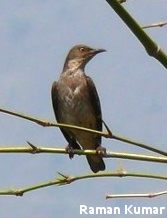
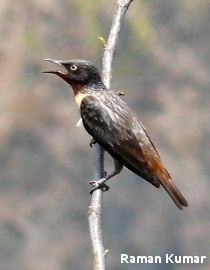
    But there are some species of birds that scoff at these conventions; instead of migrating along a north–south trajectory, these birds move east–west. Among the more celebrated of such “misfits” is the Pied Cuckoo which shuttles east–west between northeast Africa to north and central India. However, there is a lesser-known bird that shows this kind of unconventional migration – the Spot-winged Starling (Saroglossa spiloptera).

    This starling, formerly known as Spottedwinged Stare, is unfamiliar to birders from peninsular India because its distribution is limited to the sub-Himalayan and Himalayan region. Unlike mynas and most other starlings the Spot-winged Starling is sexually dimorphic: the male is a dark brownish-and-chestnut and the female is markedly paler. Both sexes sport a prominent white wing patch, giving the bird its name.

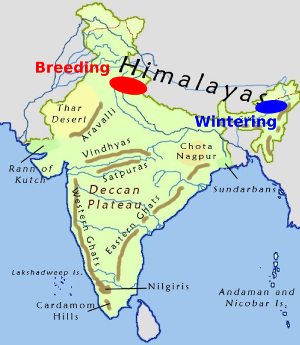
    In the Western Himalaya the Spot-winged Starling appears in late spring, feeding at fruiting and flowering trees. Small groups are often seen guzzling nectar from the blossoms of trees such as the Indian Silk Cotton. The Spot-winged Starling usually chooses open forests at elevations near 1000 m in Himachal Pradesh and Uttarakhand for breeding. Birdwatchers have seen Spot-winged Starlings at roughly the same spot in successive years, suggesting that they may remain faithful to the same place year after year, but this remains to be verified.

    Sightings become rarer in June and by July the bird virtually vacates its breeding quarters. This is the period when the Starlings are believed to make their eastward passage through Nepal and Sikkim. After this hopping flight of thousands of kilometres they set up their winter home in sub-Himalayan Assam at about 300 m elevation.

    Why do they make this unusual journey? Why don’t they winter in the terai closer to their breeding grounds? Do they breed in areas in Central Himalayas? In their 1983 epic Handbook of the Birds of India and Pakistan Salim Ali and Dillon Ripley have described the distribution of the Spot-winged Starling as “equivocal and imperfectly known”. Ornithologists haven’t added anything much beyond this and the status of this starling remains shrouded in mystery.

    Have you seen this species? Where? Do add your sightings to the MigrantWatch database so that collectively we can better understand the migration of this odd species.

    Here is the data page for Spot-winged Starling. At the time of writing, there were no records of this species in the database.

  • Participant Profile: Arun Bharos

    Category:

    Where do you live?
    I live in Raipur, the capital of Chhattisgarh.

    When did you start watching birds?

    I started birdwatching in the late 1970s. However, I became more systematic in 1980 and since then I have been maintaining a daily record of sightings of all birds and other fauna wherever I have been.

    Who would you consider your birding mentor?
    The one person who inspired me the most and initiated me into birding was my father late Mr R R Bharos, who was himself an outstanding naturalist.

    Please describe a memorable birding experience.

    While it is difficult to isolate a single event, I particularly cherish one incident in Udanti Wildlife Sanctuary back in 1985 when I encountered the White-bellied Woodpecker (Dryocopos javensis). This sighting, which was the first for the region, helped establish a crucial missing link in the distribution of the species. It was subsequently published in the Journal of Bombay Natural History Society.

    What are your favourite migrants?
    Among migrant birds I am particularly keen on waders and warblers. The more challenging the species the more interesting I find it!

    What is your favourite place to watch migrants?

    Although I like birding in heronries or wetlands, I am happy to watch birds anywhere – even at home.

    Do you have any advice for beginning birdwatchers and naturalists?

    My advice for starting birders is to have dedication and concentration. They should not hesitate to learn from experienced birdwatchers and naturalists whenever the opportunity comes.

    Why do you think people should care about birds and nature?
    There is lots to say on this, but to summarise in a sentence: because birds are excellent indicators of a healthy environment.

    Is there any other information that you’d like to share with MigrantWatchers?
    By profession I am an electrical engineer (I retired as Secretary, Chhattisgarh State Electricity Board in 2004). But I have always been a keen naturalist and have been involved in various natural history organisations. I have published about 70 articles in national and international natural history journals. I currently represent the Chhattisgarh Wildlife Society, which is one of the most active wildlife groups in the state.

    You can see Arun Bharos’s MigrantWatch contributions here.

  • Leaky clouds and the Pied Cuckoo

    Category: ,

    Rohan Chakravarty draws wonderful cartoons based on green themes. One, from a few days ago, is about How the Pied Cuckoo brings monsoons to India. Do take a look, and while you are there, check out his other bird cartoons, including the one describing 11 types of birdwatchers. As Rohan asks: which one are you?

  • Pied Cuckoo campaign in The Hindu

    Category: ,

    Today’s edition of The Hindu has an article by KS Sudhi about the Pied Cuckoo Campaign of MigrantWatch. Do take a look.

    Also, the photographer of the lovely Pied Cuckoo image is not mentioned. He is Rohan Kamath, whose MigrantWatch sightings you can see here. And here are his photos on India Nature Watch.

  • Participant Profile: Fionna Prins

    Category:


    Where do you live?
    I live in beautiful Goa, in a small village called Pilerne, about 4 km inland from the famous beaches. I stay in an old house which has a large unkempt garden which is visited by lots of birds.

    When did you start watching birds?
    I must have always been watching birds because my mother tells me that when I was about two she took me to a zoo, and apparently I only had eyes for the sparrows and starlings that were picking near the elephant’s feet, ignoring the big animals completely! Later, when I went to secondary school I had to cycle 15 km every day to get there. Most other kids would take the bus but I always enjoyed the rides because it went through a large lake area with lots of birds.

    Who would you consider your birding mentor?
    Nobody in particular but I do find that birding platforms on the web are a fantastic way to learn and exchange information.

    Please describe a memorable birding experience.
    One day, many years ago, during the first year of my bicycle rides to school, I saw two swans peeking through the reeds from their nest. Every year they would come back to the same place and we would eye each other twice a day, every day for weeks until they would appear on the lake with the new brood. Every year again it felt like a wonder.

    What are your favourite migrants?
    Well, it is always exciting to see every new arrival again. The Amur falcons always create a lot of interest but I am just as happy to see the tree pipits, pied cuckoos and rosy starlings coming back. Where we live there is also a lot of local migration which brings their own little marvels. Each arrival, each sighting, even of the most common birds, gives me hope that nature may perhaps prevail.

    What is your favourite place to watch migrants?
    We are lucky that immediately behind our house there is a hilly area where you can walk for hours rarely encountering anybody. It has a good variety of birds. Over the years I recorded more than 150 different species including a number of migrants.

    Do you have any advice for beginning birdwatchers and naturalists?
    Go out every day in the same area. This way you will learn where and when to expect the birds and how they behave. So even without fancy equipment you can have great sightings.

    Why do you think people should care about birds and nature?
    Only if there is harmony between fauna, which for me includes people, and flora, existence can be sustainable. Unfortunately, probably starting around the times of the industrial revolution, non- human life is losing out.

    Any other information that you’d like to share with MigrantWatchers?
    If we want to put strategies into place to preserve nature we need to understand it in as much as possible. To do so there is the need for data. By cross referencing various data, information can be created which allows us to design interventions which can help to preserve our wildlife, including birds. Therefore it is of utmost importance to not only keep records of sightings but also to share them as much as possible. Nature gives us sightings, we can give back by sharing our data so nature can be protected.

    You can see Fionna’s MigrantWatch contributions here, and her photos here.

  • Participant Profile: Sachin Shurpali

    Category:

    Where do you live?
    I live in Bangalore.

    When did you start watching birds?
    2007! I Started by photographing birds but lately I am trying to do only birding. Thanks to the purists in my group.

    Who would you consider your birding mentor?
    My birding mentor is Praveen J.

    Please describe a memorable birding experience.
    One of my most memorable experiences was my trip in the open ocean off the coast of Kannur, Kerala. The trip, specifically intended to look at pelagic birds, was the first of its kind, I believe, at least for the Malabar Natural History Society (MNHS) and the first time for all of us on the venture. Pelagic birding involves long hours of gazing at the sea, with mostly no birds, and add to that a bird-repelling chum in the form of vomit from fellow sea-sick birders! To start with, all the pelagic birds from the field guides were unfamiliar to us (all of them were potential lifers!). How do we really spot them if they are there? If we see them, can we get close to them at all? Would we get enough time to identify them? Will these birds tolerate us or fly several nautical miles away? On the other hand, we were warned not to get too excited with sightings and jump off the boat to get the best view among all birders and get watched as Homo sapiens pelagicus!

    It had been quite a few hours, the dullness was setting in when to our good luck we saw the first shearwaters. Our energy levels were all up to identify the birds and witness their shearing-water flight. We also soon realized that the bird activities around the fishing boats is one of the best ways to find them. Our pelagic trip ended with more than sixteen hours into the sea and maybe just two hours of actually seeing some birds. However, it was worth the effort, for we managed to see many pelagic species, including Masked Boobies, Arctic Skuas and Flesh-footed Shearwaters. An interesting entry to our list was pelagic Brahminy kites! Thanks to MNHS, Praveen J and all birders on the boat (and off boat) for this memorable experience.

    What are your favourite migrants?
    All of them, although my current interest seems to be in warblers.

    What is your favourite place to watch migrants?
    Since I largely focus on warblers, I find Hessaraghatta to be a good place for the Hippolais (also called Iduna) and Sylvia warblers, Nandi Hills for Phylloscopus warblers, and Rampura for Acrocephalus warblers (all locations around Bangalore).

    Do you have any advice for beginning birdwatchers and naturalists?
    I recommend them to read Bill Oddie’s Little Black Bird Book. (Thanks to Mike for his insistence.)

    Why do you think people should care about birds and nature?
    On a lighter note, because it’s fun, and on a serious note we must ensure that the next several generations have fun!

    Any other information that you’d like to share with MigrantWatchers?
    MigrantWatch is a good initiative in documenting our avifauna and thus contribution to the same will be key to continuation of ecological studies which are important for the healthy survival of all.

    You can see Sachin’s MigrantWatch contributions here.

  • Re-Booting the identification of Hippolais warblers

    Category: ,

    By R. Jayapal

    Dr R. Jayapal is an assistant professor at the School of Human Ecology, Ambedkar University, Delhi. Essentially a birdwatcher trained in wildlife ecology and conservation, he has been doing ecological research on birds for more than 15 years, and has worked in various landscapes across India ranging from the Central Indian Highlands of Madhya Pradesh to the trans-Himalayas of Ladakh.

    Until the 1990s, life used to be simple and straightforward for a serious warbler-watcher in the Subcontinent. One would know this was a Chiffchaff and that was a Booted Warbler. Although both had two subspecies wintering in our region, one normally wouldn’t bother about that as all the literature would say it was nearly impossible to identify them unless in hand. I also suspect that just identifying them authoritatively as a Chiffchaff or a Booted Warbler in the field was esoteric enough to impress and awe others. But things changed with the increased use of DNA to lump or separate species, supported by analysis of vocalizations in the field. These developments have both advanced the science of taxonomy and jolted us good old birdwatchers and subverted our long-cherished complacency.

    The Chiffchaff has been split into Common Chiffchaff and Mountain Chiffchaff (actually more, but that’s another story) and the erstwhile Booted Warbler has been found to consist of two species – Sykes’s Warbler (Hippolais rama) and Booted Warbler (Hippolais caligata). [They were initially treated so in 19th century, but then that was before the era of trinomial nomenclature].

    Now to the mundane, but yet the most pertinent question –– is it possible to differentiate these two Hippolais warblers in the field? The answer is Yes and No… Yes, if you are careful to note down some subtle yet distinct field-characters and fortunate to observe the birds in fresh plumage closely. No, if you are a birder like me who does not have those discerning pair of eyes and who has this inexplicable habit of always encountering birds in worn plumage or moult, or worse, individuals showing intermediate characters (Apparently, they do hybridize).

    To begin with, a birder is more likely to come across two types of Hippolais warblers: one that looks like a reed-warbler (Acrocephalus) but behaves typically like a leaf-warbler (Phylloscopus), and another the other way round. If this peculiarity strikes you in the field, well, half the battle is won. [Warning: Judging a bird as a look-alike or behave-alike can become subjective].

    Sykes’s Warbler (H. rama), with a longer bill and a longer, graduated (i.e., narrowing in steps) tail, looks strikingly (!) like an Acrocephalus reed-warbler. It also has a relatively longish body (from bill to tail tip) that is accentuated by somewhat longer under tail-coverts. But, despite its reed-warbler-like appearance, its foraging behaviour is strangely reminiscent of a Phylloscopus leaf-warbler. You can see it actively gleaning and flycatching in the middle- and top canopy of tall shrubs and low trees, rarely descending down to ground-level vegetation. Both the Hippolais often twitch and flick open their tails, and while doing so, rama’s graduated tail feathers are hard to miss.

    Other diagnostic characters of rama may be either difficult to observe in the field or may not always be conspicuously present in all the individuals. These include: a completely pale yellow lower bill lacking any dark-tip, absence of darker margin to the short white supercilium (just above the lores), and pinkish-brown legs (which are slightly darker compared to caligata’s pale yellow tarsus).

    Booted Warbler (H. caligata) has a comparatively shorter bill and a squarish, shorter-looking tail with an abruptly-ending belly (owing to much shorter under tail-coverts). These features make the bird look rather like a Phylloscopus leaf-warbler. H. caligata distinctly lacks the proportionately long body plan of rama. When the tail is twitched open, the Phylloscopus-like squarer tail feathers are quite unmistakable (contra rama). The Booted Warbler invariably forages like an Acrocephalus reed-warbler among the undergrowth and herbage at the ground-level (though more tame than many Acrocephalus). It does, however, occasionally visit the middle canopy only to return to lower vegetation in a moment or so.

    As described under rama, there are other diagnostic characters of caligata that may not always be useful in the field. These include a dark-tipped pale lower-bill, a dark supra-ocular margin just above the lores (present only in fresh plumage), and paler looking legs.

    It is important to note that both rama and caligata have almost indistinguishable calls in their winter quarters – a hard and dry chuk. And it should be remembered here that NOT ALL individuals are identifiable with certainty in the field, as individuals with intermediate characters are ‘not uncommon’ (ah, what a wonderful phrase!). There have also been recent revisions in the taxonomy of Family Acrocephalidae resulting in placement of both these Hippolais taxa in the genus Iduna along with Thick-billed Warbler.

    One should also keep in mind that the wintering ranges of both rama and caligata have not been completely worked out as all our current understanding is based on museum collections and subspecies identity was not possible in a majority of past sight records (For more information, see P.C. Rasmussen & J.C. Anderton, 2005. Birds of South Asia: The Ripley Guide. Smithsonian Institution, Washington DC & Lynx Edicions, Barcelona). For all practical purposes, both taxa are likely to occur in most parts of the Subcontinent (probably except the higher Himalayas and north-eastern hills) either as winter visitors or passage migrants.

    If you do find these tips helpful (or hopeless) in the field, please do write to me as that would greatly reassure me (that I am not alone).

    ———————–
    You can contact R Jayapal at rajah.jp[at]gmail[dot]com

  • Participant Profile: Dr Raju Kasambe

    Category:

    Where do you live?
    I live in Dombivali (East), district Thane, Maharashtra; and I work at the Bombay Natural History Society (BNHS), Mumbai.

    When did you start watching birds?
    I started watching birds way back in 1996.

    Who would you consider your birding mentor?
    There was no person in particular who mentored me. Salim Ali’s Book of Indian Birds was my only guide in the beginning.

    Please describe a memorable birding experience.
    In the middle of one hot summer I had gone to the Upper Wardha Dam along with a young birder Nandkishor Dudhe in search of passage migrants. In the afternoon we stumbled upon a huge nesting colony of the Blue-tailed Bee-eaters (Merops philippinus) with around 2,000 nests holes in the river cutting! It was a most fascinating sight. Later I studied the breeding behaviour of these Bee-eaters for my M.Sc. dissertation.

    What are your favourite migrants?
    I have a lot of favourites among migratory birds, but the ones I like most are Blue-tailed Bee-eaters, Common Cranes, and Sociable Lapwings.

    What is your favourite place to watch migrants?
    My all-time favourite birding spots to watch migratory birds are the Pohara Tank in Amravati district, the Wana Dam in Nagpur district, and the Sewri mudflats in Mumbai.

    Do you have any advice for beginning birdwatchers and naturalists?
    Birdwatching is a fascinating hobby. Do it with passion and it will reward you with new knowledge every time you go out, besides giving you new vigour to work.

    Why do you think people should care about birds and nature?
    If you cannot give, at least don’t destroy whatever natural heritage we have left.

    Is there anything else you’d like to share with MigrantWatchers?
    I worked as a medical representative with a premier pharmaceutical multinational company for 18 long years. My work involved a lot of travelling. It was during these tours that I nurtured my passion for birds, often carrying binoculars and camera in the bag. I enrolled for a Ph.D., which I pursued while on my job. Upon submitting my thesis, I said goodbye to the pharmaceutical company and joined BNHS as Project Manager for the Important Bird Areas Programme in April, 2010. Now my passion and the profession are same!

    You can see Raju Kasambe’s MigrantWatch reports here.

  • Manipal in winter

    Category: ,

    By Ramit Singal

    Ramit Singal is an engineering student studying in Manipal. He has been interested in birds ever since he was gifted Martin Woodcock’s Birds of the Indian Subcontinent about 10 years ago. Birding is now a serious hobby of his. He tries and devotes as much time to birds as possible and is trying hard to make birding an established hobby amongst students within his campus. He has been in Manipal for 2.5 years, and he (irregularly) maintains his journals at http://manipalbirding.tumblr.com/


    Manipal is a small town located in the Udupi district of Karnataka, and situated quite favourably at an equal distance from the Western Ghats to the east and the Arabian Sea to the west. Manipal is best known for its university, but it is also endowed with a diverse range of habitats and, as a direct consequence, a diverse population of birds. The area hosts nearly 190 species of birds, a good 40 of which are seen only during the winter months. However, not all of them are migrants that cross international borders, or are palaeartic – many are local migrants or those that breed in the northern plains but winter in the south (Eg. Blue-tailed Bee-eater).

    In terms of migrants which are palaeartic – the number drops down slightly and becomes 30, still fairly impressive. This ’30’ includes all forms of birds – waders, warblers, raptors, etc but Manipal has thus far failed to attract any wintering waterfowl, despite suitable habitat being available.

    While I will get down to the nitty-gritties of the species and the frequencies of their sightings later, I want to put down a few words regarding the habitats in Manipal. There are three main different types of birding locales in this small town, all within one kilometre of the other. One of the most productive is the man-made Manipal Lake – a waterbody that dries up on the shores just in time for incoming waders to reap the benefits of the now available mudflats and vegetation. Another – and my favourite site in the region – is the Eshwar Nagar woodlands. These are basically the forests of yore, of which only a few fragments remain – the rest being grasslands (what were old paddies) or cultivation. However, there is just about enough in the area to keep it going and flourishing as a birdwatching site. Lastly, and the only site with any tourism in Manipal – End Point. This region is the edge of the plateau between the ghats and coastal plains and comprises of scrubby laterite hillsides and secondary forests.

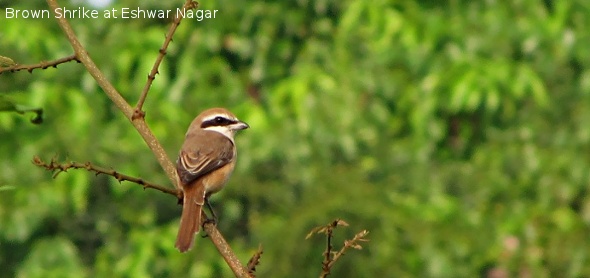
    As the monsoons end in mid September and leave behind massive puddles in the laterite patches of End Point, the first waders – usually sandpipers and sand plovers are seen. They depart as soon as the water dries up, leaving behind the right habitat for the incoming flocks of Greater Short-toed Larks and other such birds – wagtails and pipits. The waders instead move on to the much wetter and much richer ecosystem of the Manipal Lake. Aggressive Ashy Drongos also start taking over every suitable perch possible. This is also the time when the open areas within forests get their first Brown Shrikes, which are noisiest at the start as they mark out their territories for the coming winter. By the time October’s first week ends, wintering and on-passage Brown Flycatchers, Bright Green and Greenish Warblers, Booted and Blyth’s Reed Warblers, and Barn Swallows can be seen anywhere – every garden and compound. The Bright Green Warblers (subspecies nitidus of the Greenish Warblers; but often considered a separate species) are the most common winter migrants in the region, closely followed by the Acrocephalus/Hippolais warblers and Ashy Drongos.

    Amidst huge flocks of Chestnut-tailed Starlings, the Eshwar Nagar woodland throws up the most fascinating birds every now and then. Apart from the recent Broad-tailed Grassbird, the winters bring to it the odd Black-naped Oriole and varying populations of Oriental Turtle Doves. It also holds the largest numbers of Green(ish) Warblers and Blyth’s Reed Warblers – the latter probably because of the extra bit of moistness early morning :-). Almost 90% of all Brown Shrikes in Manipal winter in this patch and Marsh Harriers patrol the nearby paddyfields for the odd waders, crakes, and possibly Lesser Whistling Teals.

    The open grassland and scrubby vegetation that the laterite hillsides of Manipal naturally provide are good areas for the Common Stonechat – a regular but scarce visitor, a status it shares with the Tree and Blyth’s Pipits – both of which are also found in similar habitats (although the Tree Pipit does like the presence of trees around it a lot more :-). As the sun rises, the Booted Eagles also rise up with it. The Common Kestrel is a rare winter migrant here, this is the right habitat to find one. All of these arrive post mid-October in general.

    Due to human intervention, these same hillsides have been flattened at the top of End Point, but this move has put the habitat in good favour with passage flocks of over 500 Greater Short-toed Larks especially on return migration in February, as well as birds like the Grey-necked Bunting, which stayed for >3 weeks in Feb 2011, and Yellow and White Wagtails, the latter of which is the commonest wintering wagtail and is present in very good numbers from late November onwards. The Grey Wagtail is surprisingly rare, only seen around the discharge streams coming from the Manipal Lake. Manipal has several fields and grounds for sports that are used in the early mornings by birds. Their moist surface again brings together a few wagtails and waders – stints and Redshanks being especially fond of such habitats.

    Speaking of man-made habitats, of note perhaps is the Peregrine Falcon (subspecies calidus) that stayed for a week in October 2009 and perched regularly on the boys’ hostels in the engineering college’s campus!

    All in all, while the number of migrants may not be astounding, Manipal never fails to throw in a new surprise each winter. Its geographical location makes it an ideal place for getting the odd bird on passage between the extreme south and the west. All it really needs is more eyes to be on the lookout for any unusual sightings in its very varied landscape.

    Here are links to Ramit’s MigrantWatch sightings and photographs.