
MigrantWatch

MigrantWatch archive (2007–2015)
Report migrant sightings on eBird India · about this archive

Cranes flying against an orange sky
  • Participant Profile: Dr. Jayan Thomas

    Category:

    Where do you live?
    I live in the coastal city of Cannanore (Kannur) in Kerala.

    When did you start watching birds?
    As a lad I was interested in birds, but mostly as targets for my Diana .22 air gun! Then I joined medicine and became an eye specialist and forgot all about it. However, my curiosity about birds and their behaviour was sparked again in the year 2004 when at the beach I witnessed a Blue-tailed Bee-eater catch a bee, smash it against a wire and swallow it. From then on I began birdwatching more seriously.

    Who would you consider your birding mentor?
    My mentor is Mr. P.C. Rajeevan who is arguably one of the greatest birders in Kerala. His motto is “ birding all day”. I learned my birding basics from him. I was also inspired by birdwatchers like Mr. Sashikumar and Praveen J. and received support from Suhel Quader and Aasheesh Pittie.

    Please describe a memorable birding experience.
    Sighting of the Buff-breasted Sandpiper at Cannanore by Rajeevan and myself was the greatest birding moment of my life. This is a North American bird which had never before been reported from South Asia! I was giddy with excitement at this sighting. Moreover, I received a certificate from the Limca Book of Records for becoming the first Indian to ever take the photo of the Buff-breasted Sandpiper in South Asia.

    What are your favourite migrants?
    Since I live by the sea, my favourite migrants are, of course, the waders. Waders are the most engaging  birds whose identification may be challenging too. Just watching them gives me great joy.

    What is your favourite place to watch migrants?
    My favourite birding playground is Madayipara, which is a laterite hillock on the coast, 23 km from Cannanore. Madayipara is the place for passage migrants in Kerala. Some of the migrants seen here are the Buff-breasted Sandpiper, Oriental Pratincole, Tawny Pipit and Isaballine Wheatear.

    Do you have any advice for beginning birdwatchers and naturalists?
    Birdwatching is great fun, but one has to be honest with their data and sightings. Not seeing a new bird is nothing to be ashamed of, but faking sightings certainly does make one a bad birdwatcher. Naturalists should be pragmatic to their approach on all issues concerning nature.

    Why do you think people should care about birds and nature?
    The world is for everyone both big and small. Homo sapiens and birds are like the sides of the same coin. We can’t live separately. We either live together or perish together.

    Any other information that you’d like to share with MigrantWatchers?
    MigrantWatchers are doing a wonderful job tracking birds across India. The eye does not see what the mind does not know. Hence, riffling through one’s favourite bird book once in a while and learning about various migrants is an excellent way to get familiar with them and identifying them in field.

    You can see Dr. Jayan Thomas’s MigrantWatch contributions here, and his photos here.
  • October round-up

    Category:

    The monthly round-up of what’s been happening at MigrantWatch has just been sent to all participants. If you are registered with us, but haven’t received this email, please check your spam folder; and add mw@migrantwatch.in to your address book. Do send us a message if you have any questions.

  • Dewar’s bird calendar – November

    Category: , ,

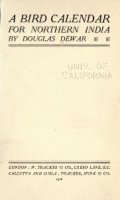
    Some extracts from Douglas Dewar’s A Bird Calendar for Northern India, published in 1916. Have you heard the a-onk of a Brahminy Duck (Ruddy Shelduck), or a Coppersmith say wow, or the honking of geese overhead in the night?

    From the crowded jhil emanate the sweet twittering of the wagtails, the clanging call of the geese, the sibilant note of the whistling teal, the curious a-onk of the brahminy ducks, the mewing of the jacanas and the quacking of many kinds of ducks. … The green barbets also call spasmodically throughout the month, chiefly in the early morning and the late afternoon, but the only note uttered by the coppersmith is a soft wow. The hoopoe emits occasionally a spasmodic uk-uk-uk.

    The migrating birds continue to pour into India during the earlier part of November. The geese are the last to arrive, they begin to come before the close of October, and, from the second week of November onwards, V-shaped flocks of these fine birds may be seen or heard overhead at any hour of the day or night.

    The nesting activities of the fowls of the air are at their lowest ebb in November. Some thirty species are known to rear up young in the present month as opposed to five hundred in May. In the United Provinces the only nest which the ornithologist can be sure of finding is that of the white-backed vulture.

    The nesting season of the tawny eagle or wokab (Aquila vindhiana) begins in November. … The man who attempts to take the eggs or young of this eagle must be prepared to ward off the attack of the female, who, as is usual among birds of prey, is larger, bolder and more powerful than the male. At Lahore the writer saw a tawny eagle stoop at a man who had climbed a tree and secured the eagle’s eggs. She seized his turban and flew off with it, having inflicted a scratch on his head. For the recovery of his turban the egg-lifter had to thank a pair of kites that attacked the eagle and caused her to drop that article while defending herself from their onslaught.

    Taken, with grateful thanks, from Project Gutenberg.

  • A massacre of falcons

    Category: , ,

    Conservation India reports on the mass-hunting of migrating Amur Falcons in Nagaland. These superb little raptors migrate from their breeding grounds in and around northeastern China all the way through India and to their wintering quarters in southern Africa. Along the way they gather in large numbers in northeastern India, where they are vulnerable to being caught.

    Please check the Conservation India site for further updates on the situation. And in the meantime, do report your Amur Falcon sightings to MigrantWatch so that information on the occurrence and migration of this beautiful bird is available in one place. If you have seen large numbers congregating in one place, and are concerned about making this information public, please do contact us over email: mw@migrantwatch.in

  • Subscribe to the blog via email

    Category:

    We have added another way for you to be notified when any new material appears on the blog. Just enter your email address in the “straight to your inbox” form on the right panel here; and new blog posts will be delivered, well, straight to your inbox! You can unsubscribe at any time if you don’t like it.

    Or, click on the little red icon just below the search box on the right to subscribe to the feed.

  • Rosy Starlings over 5 years

    Category: , , ,

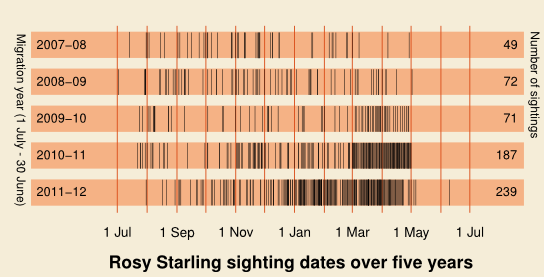
    In the course of putting the MigrantWatch 5-year report together, we are looking at migration timings of various species. Here are the sightings of one species — Rosy Starling — in the database.

    Each sighting is indicated with a vertical black line, just as in this image of sightings of several species.

    You can see that Rosy Starlings arrive quite faithfully in mid-to-end July, and leave fairly punctually at the end of April or very early in May. There are a small number of exceptional sightings: as early as 2nd July in 2008-09 (by Arpit Deomurari in Jamnagar); and as late as 10th June in 2011-2012 (by Tushar Takale in Nagpur – this is also supported by a photo).

    Because we have simply put all sightings together, the first and last sightings of the season really only reflect what is happening in northwest India. As the number of sightings increase, regional arrival and departure dates will be interesting to look at.

    You can see all Rosy Starling sightings in the database here.

  • 5 years of MigrantWatch

    Category: ,

    From the MigrantWatch Newsletter, September 2012
    It has been just over five years since MigrantWatch began, and we are in the process of compiling all records from the first 5 years into a report. In case there are observations that you have not yet uploaded we request you to please do so. This will enable your records to be included in the report. Watch out for more updates on the report.

    Have you been receiving the MigrantWatch newsletter? If you are registered with us, but have not been receiving the monthly newsletter, you can view the September edition here. Please also add mw@migrantwatch.in to your address book so that mail from us doesn’t get wrongly marked as spam.

  • 15000th record on MigrantWatch

    Category: ,

    From the MigrantWatch Newsletter, September 2012.
    With Jayant Wadatkar’s sighting of the Pied Cuckoo near Amravati, Maharashtra, on 22 September 2012, we have reached another milestone. This was the 15,000th record to be logged on to MigrantWatch. By complete coincidence, the 10,000th sighting on MigrantWatch was also from Amravati!

    Congratulations to all MigrantWatchers for helping reach this landmark!

    Have you been receiving the MigrantWatch newsletter? If you are registered with us, but have not been receiving the monthly newsletter, you can view the September edition here. Please also add mw@migrantwatch.in to your address book so that mail from us doesn’t get wrongly marked as spam.

  • Leaf warbler ID made easy! Part II: Wintering & Breeding

    By Mousumi Ghosh
    Read Part I in this series of articles on leaf warblers

    Wintering Season

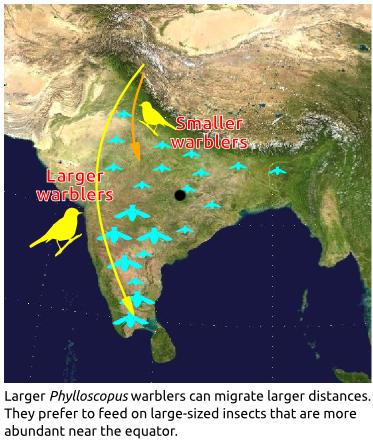
    To most of us, Phylloscopus leaf warblers belong to just one size category: tiny! And confusing. Every winter, these diminutive and inconspicuous birds envelope the subcontinent in a wave, migrating thousands of kilometres south from their breeding grounds in the Himalayas and beyond. Migrating long distances takes a lot of energy, particularly for smaller species. Small differences in body weights among species make a huge difference in deciding how far they have to travel for wintering. Small-sized warblers are geared to feed on small insects, which are available in good quantities right from the Himalayan foothills all the way down south. The larger Phylloscopus warblers (like Large-billed, Greenish, and Western-crowned) do not have it so easy, as their preferred food – large insects – are available in adequate supply only further south. Hence, in the wintering season smaller species don’t travel very far, with their southern limit being either the sub-Himalayan foothills (e.g. Lemon-rumped Warbler) or mostly up to Central India (e.g. Hume’s Warbler), where wintering ranges of larger species begin. In contrast, larger species  (e.g. Greenish and Western Crowned Warblers) travel farther south and all way to southern India and Sri Lanka.

    A great deal of knowledge about the wintering ecology of Greenish Warblers has emerged from Madhusudan Katti’s work in the Kalakkad-Mundanthurai forests of Tamil Nadu. He found that individual birds, quite remarkably,  come back to the same wintering territory year after year!  Also, in years of scanty rainfall and limited food the birds were unable to eat enough to moult in time for their long journey back to their breeding sites. This shows how conditions in their wintering habitats may influence whether birds are able to make it back to breed; and this has obvious implications for the size of the population.

    Several parallels exist between the way these birds breed and winter. For example, the species which breed on “top of the mountains” (Hume’s  and Greenish Warblers) spend the winter on “top of the trees”. Interestingly, while these two species are territorial in winter (both males and females defend territories), others, like the Western-crowned and Lemon-rumped Warblers, join mixed-species flocks. Although most species spend their breeding and wintering seasons in drastically different forests, they use similar foraging techniques. For instance, the Lemon-rumped Warbler (which breeds in conifer-mixed forests and winters in sal forests), mostly captures prey by hovering in the outer foliage of trees in both seasons.

    Breeding Season

    The Himalayas, because they provide such a huge variety of habitats, harbour one of the richest communities of leaf warbler species in the world. Twenty-one out of  the world’s 61 species of Phylloscopus are found in the Himalayan region. They occupy the entire range of habitats from tropical evergreen/deciduous forests in the foothills to the alpine meadows above the treeline. In the Himalayas the elevation zone 2500–3000 m supports the highest diversity of breeding warblers, where up to 9 species may breed together.

    How do so many similar species coexist in one place? One reason is that while superficially leaf warblers are very similar, different species possess differently sized body parts. This is associated with differences in foraging behaviour. For instance, larger species eat larger insects and species with wider beaks catch more flying insects. Another way to allow coexistence is by occupying different elevation zones. To avoid competing for similar food using similar methods, each altitudinal zone in the mountain typically has one large species, a medium species and a small species, which capitalize on prey in accordance to their body sizes.
    The overall drab colours of leaf warblers conceal subtle differences which not only indicate the habitat that they breed in, but also help in communicating and selecting mates. To the trained eye, visually distinguishing most of the leaf warblers involves relying on presence, number and colour of brighter patches such as wing bars, supercilium, rump patch and crown stripes. Species occurring in dense habitats, such as the Lemon-rumped Warbler, typically possess many bright patches (two wing bars, a distinct supercilium, crown stripe and rump patch). Such warblers often flash these patches to communicate. Additionally, males with brighter and longer wing bars are of higher quality (such males occupy larger territories) and are preferred by females. On the other hand, the Tickell’s Warbler, which breeds in open Juniper scrub, has no bright patches at all.

    To be continued…Coming up next in this series: Tips for Identification of Phylloscopus Warblers

  • Leaf warbler ID made easy! Part I: Introduction

    Category: , , , ,

    By Mousumi Ghosh

    When I started birding seriously in the year 2005 after joining the Master’s course at the Wildlife Institute of India, I conveniently ignored every warbler I saw. Since visual identification was very difficult (given their frustratingly similar and drab appearances), I was happy enough to say that so-and-so bird was of a warblerish persuasion, and leave it at that. But then, as fate would have it, I wound up studying the wintering ecology of three species of leaf warblers in the Himalayan foothill forests of Himachal Pradesh for my MSc dissertation. While my primary motivation was to understand how they survive the winter sharing dwindling food resources, I now had to identify them accurately for my work to make any sense.

    In most situations a bird in hand is worth two in the bush, but when it comes to identifying leaf warblers it is better to have a bird singing in the bushes than have even ten in your hand! This wisdom came to me from my supervisors Mr. Pratap Singh and Dr. Dhananjai Mohan, who taught me how to identify leaf warblers in the field from their calls and song.

    These remarkable little birds belong to the family Phylloscopidae, whose members are dressed in various hues of dull green, yellow, grey and occasionally bright chestnut (as in the Chestnut-crowned Warbler). They are among the commonest species of European and Asian forests. The word Phylloscopus literally means ‘looking into the leaves’ and this aptly describes our industrious friends, who spend almost 75% of their waking hours searching for insects among the leaves. 

    The genus is famed for its astounding diversity: more than 60 species of Phylloscopus are described. Most of them breed in the temperate areas of Europe and Asia. Despite weighing only 5-10g, some leaf warblers migrate over thousands of kilometres to arrive in their wintering quarters in the tropics of Africa and South Asia, including the Indian subcontinent. To cite an example, Hume’s Warbler (weighing just about 6 g) covers almost as much distance as the celebrated Siberian Crane (weighing 6 kg) to reach the plains of India from where it breeds in Siberia!

    The same attributes which make them so difficult to identify (so many species, yet so similar in appearance) have made them one of the most well-studied groups of birds in the world. Within India, detailed studies of their breeding (in the Himalayas) and wintering ecology (Himalayan foothills, peninsular India) by Dr. Trevor Price and his students have revealed a great deal about these leaf warblers in both breeding and wintering seasons.

    Read Part II of this series of articles on leaf warblers