[Read Part I: Why]
 As part of our ongoing effort to move the entire MigrantWatch database to eBird, we will be asking you to undertake a few simple steps. Doing this will ensure that all your existing data are safely transferred to the eBird database, and are copied to your eBird account.
Here is the sequence of events:
- Data submission will be disabled on the MigrantWatch website from 10 August onwards.
- All MigrantWatch data will be uploaded to eBird by 15 August 2015. The information will be initially stored under an account with name MigrantWatch (group account).
- Thereafter, your migrant observations will be ‘shared‘ with you from the MigrantWatch group account. Here is the procedure:
— Please ensure that you have an eBird account. If you don’t already, it’s easy to sign up.
— You will receive emails asking you to accept your observations (called ‘lists’ in eBird) into your eBird account.
— As soon as you accept these lists, they will be copied into your eBird account.
— You may have to accept multiple lists, but once you have done so, nothing more needs to be done.
— Any photographs that you have put up on MigrantWatch will also be automatically embedded into your observations.
— Once you’ve successfully migrated to eBird, we urge you to submit all your subsequent observations and pictures through your eBird account.
|
We encourage you to please visit Bird Count India for more about eBird, tips for its use, and related topics.
Please also see Part 1 of this post in which we have outlined how (and why) MigrantWatch data are being moved to eBird.
Do write to us at mw@migrantwatch.in if you have any questions or need any assistance about migrating to eBird.
Since 2007, MigrantWatch has brought together hundreds of birders across India to pool our observations of migratory birds. Over the years MigrantWatchers have collectively contributed more than 30,000 observations — a commendable effort indeed!
in the future, we’d like to make it more enjoyable and easy to share bird sightings. We’d also like to make the information contributed as valuable as possible for research and conservation. In order to achieve these goals we need to transition to the next level. This is where eBird comes into the picture.
eBird has a lot to offer for the birdwatcher, for example:
- a global, birder-friendly platform – eBird is used by tens of thousands of birders across the world to maintain their birding lists. It currently holds millions of bird records and is very easy to use.
- a comprehensive database for your observations – When you go out birding you watch all birds, and not just migrants. eBird enables you to upload complete lists of the birds you saw during a particular trip. This means you have the convenience of keeping a full record of all your birdwatching sessions at one place.
- exciting features to enhance your birdwatching experience – eBird makes it easy to upload your birding lists, allows you to explore your records through exciting visualizations, helps you maintain your life lists and makes sharing your bird lists very simple. You can also embed photos, videos or sound files to accompany each sighting. What’s more, you can use a smartphone app to submit data to eBird.
- higher quality data for research and conservation – Complete lists, as encouraged by eBird, provide information on not only which species are present, but also about which ones are absent. This kind of information is of greater value than presence-only information. The data on eBird is also ported up to the Avian Knowledge Network and the Global Biodiversity Information Facility, through which anyone can explore and download all the data.
- increasing use in India – over the past 1.5 years, birdwatchers in India are increasingly using eBird to maintain their birding records and to run bird projects. eBird in India is administered by the Bird Count India partnership, of which MigrantWatch is a member, together with a large number of other Indian groups. Currently, over 1.7 million bird observations have been uploaded by Indian birders, thus making eBird the largest database on birds of India.
As you know, MigrantWatch has been partnering with eBird since 2013 and we have been encouraging you to upload your observations through eBird. A large number of MigrantWatchers have now completely moved to eBird to log their observations. Our next step is to migrate the entire MigrantWatch data to eBird during which all your MigrantWatch observations will be safely transferred to the eBird database and to your account in eBird.
As part of this exercise you would be required to do a few simple things to transfer your MigrantWatch records to eBird, which are described in Part 2 of this post: How.
The latest news at MigrantWatch has been emailed to all participants via the May/June 2014 issue of our round-up. You can see an archive of these messages here.
If you are registered with us, but haven’t received this email, please check your spam folder; and add mw@migrantwatch.in to your address book. Please send us a message if you have any questions.
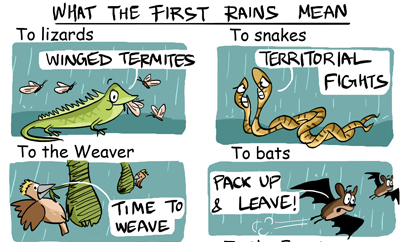 Master cartoonist, keen observer of nature, and wry observer of birdwatchers, Rohan Chakravarty has drawn a cartoon-poem on the meaning of the first monsoon rains.
The image here is only a snippet. Follow the link and scroll down to see why we at MigrantWatch particularly love this cartoon.
Thanks, Rohan!
PS. Rohan’s Green Humour blog is full of wonderful cartoons and trenchant observations — do take a look!
As regular MigrantWatchers know, we run a Pied Cuckoo Campaign every year, from May to August. The idea behind this campaign is to better understand the timing of migration of the species, as it wafts across the Arabian Sea from east Africa to land on our soon-to-be-green land. More specifically, this applies to the population of Pied Cuckoos that migrates to central and northern India; in southern India, the species can be seen year-round (as you can see from these nice eBird maps on the Bird Count India website).
Over the years (the campaign started in 2009), your sightings of Pied Cuckoo have enabled a better understanding of its migration in relation to the onset of the monsoon. You can see some summaries of the information collected on various MigrantWatch blog posts, including an analysis of the very first campaign, a comparison between 2009 and 2010, and animated map of Pied Cuckoo sightings, and a summary of four years of arrivals in relation to the monsoon.
Please do be on the looking for the species, and remember that you can contribute your observations to either MigrantWatch or eBird.
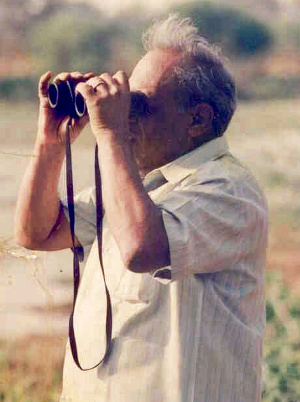
We are happy to announce that the MigrantWatch database has now crossed 30,000 reports of Indian migrants. The 30,000th report was of 50 Rosy Starlings from near Basni in Chhattisgarh. It was uploaded by veteran MigrantWatcher Mr Arun MK Bharos, pictured here.
Mr Bharos was profiled on this blog earlier, and you can see all his MigrantWatch sightings here.
Here are links to the announcements of earlier landmarks: 25,000th sighting | 20,000th sighting | 15,000th sighting | 10,000th sighting
The growing database of migrant sightings owes its existence to participants like Mr Bharos and all other MigrantWatchers. Thank you for all your efforts!
 As we announced earlier, MigrantWatch is working more and more closely with eBird to make the two databases compatible such that sightings reported to either website can easily be collated to understand patterns of bird migration in India.
We encourage you to submit you observations to eBird, especially if you are listing all species (resident and migrant) that you observe on a bird outing. Now, a new series of monthly birding challenges for India adds a bit of fun to our birding and listing activities. Bird Count India, a consortium of organizations and groups interested in bird listing and monitoring, is running these monthly challenges, which has a particular goal or target for participants each month.
Do take a look, and we encourage you to participate! The challenge for May is to upload at least four complete lists to eBird each week of the month. The details are here.
GBBC 2014 was a record event for India! Over 1,100 birders participated, contributing more than 3,000 lists, which contain observations of 823 species — this is the largest number of species contributed to the GBBC by any country in the world!
Visit this link to see the results for GBBC India, lists of participants, and other interesting details.
Many thanks to all who contributed! But the story doesn’t end with GBBC. Here is an exciting activity for all of us to take part in — the eBirding Challenge for India — which started on 1 April 2014, and will continue all through the year.
Species names in MigrantWatch have remained unchanged since the start of the project, and an update is long overdue. We have now changed the names of some of the species in the MigrantWatch database, following following recent revisions in taxonomy and nomenclature.
As part of our efforts to integrate more closely with eBird, we decided to follow the eBird naming system, which, in turn, is synchronized with the Clements Checklist of the Birds of the World.
A practical consequence of this is that it is now much easier for you to upload your MigrantWatch sightings to your eBird account if you wish to do so. Note that the scientific names of species in MigrantWatch now match Clements/eBird exactly, and the English names are the same as if you set your preferences in eBird to “English (India)” as recommended for Indian birders.
A concise summary of changes is given below for your convenience (the complete list of changes can be downloaded here: MW name changes 2014-03-23). We urge you to refer to this list before submitting observations.
Both English and scientific names changed
|
Old name
|
Updated name
|
Notes
|
|
Common Stonechat
|
Saxicola torquata
|
Common/ Stejneger’s Stonechat (Siberian Stonechat)
|
Saxicola maurus
|
The former Common Stonechat has been split, following which the species in India is the Siberian Stonechat, S. maurus.
|
|
Eurasian Golden Oriole
|
Oriolus oriolus
|
Indian Golden Oriole
|
Oriolus kundoo
|
The former Eurasian Golden Oriole has been split, following which the species in India is the Indian Golden Oriole, O. kundoo.
|
|
Orphean Warbler
|
Sylvia hortensis
|
Eastern Orphean Warbler
|
Sylvia crassirostris
|
Orphean Warbler has been split, following which the species in India is the Eastern Orphean Warbler, S. crassirostris.
|
English name changed
|
Old name
|
Updated name
|
Notes
|
|
Eurasian Skylark
|
Skylark (Sky Lark)
|
|
|
Grasshopper Warbler
|
Common Grasshopper-Warbler
|
|
|
Red-throated Flycatcher
|
Red-breasted Flycatcher
|
The former Red-throated Flycatcher had two subspecies, which are now recognised as separate species: Red-breasted and Red-throated. The Red-breasted Flycatcher retains the scientific name Ficedula parva, while the red-throated form is now Taiga Flycatcher Ficedula albicilla
|
|
Red-breasted Flycatcher
|
Taiga Flycatcher
|
|
Spangled Drongo
|
Hair-crested Drongo
|
Hair-crested Drongo retained to prevent confusion with the Spangled Drongo found in Australia
|
Scientific name changed
|
Old name
|
Updated name
|
Notes
|
|
Alpine Swift
|
Tachymarptis melba
|
Apus melba
|
|
|
Asian Brown Flycatcher
|
Muscicapa dauurica
|
Muscicapa latirostris
|
|
|
Black-headed Gull
|
Larus ridibundus
|
Chroicocephalus ridibundus
|
|
|
Black-winged Cuckooshrike
|
Coracina melaschistos
|
Lalage melaschistos
|
|
|
Booted Warbler
|
Hippolais caligata
|
Iduna caligata
|
|
|
Bridled Tern
|
Sterna anaethetus
|
Onychoprion anaethetus
|
|
|
Bristled Grasswarbler
|
Chaetornis striatus
|
Chaetornis striata
|
|
|
Broad-billed Sandpiper
|
Limicola falcinellus
|
Calidris falcinellus
|
|
|
Brown-headed Gull
|
Larus brunnicephalus
|
Chroicocephalus brunnicephalus
|
|
|
Buff-breasted Sandpiper
|
Tryngites subruficollis
|
Calidris subruficollis
|
|
|
Caspian Tern
|
Sterna caspia
|
Hydroprogne caspia
|
|
|
Demoiselle Crane
|
Grus virgo
|
Anthropoides virgo
|
|
|
Dusky Thrush
|
Turdus naumanni
|
Turdus eunomus
|
The former Turdus naumanni has been split
|
|
Eurasian Crag-Martin
|
Hirundo rupestris
|
Ptyonoprogne rupestris
|
|
|
Firethroat
|
Luscinia pectardens
|
Calliope pectardens
|
|
|
Great Black-headed Gull
|
Larus ichthyaetus
|
Ichthyaetus ichthyaetus
|
|
|
Greater Spotted Eagle
|
Aquila clanga
|
Clanga clanga
|
|
|
Grey Bushchat
|
Saxicola ferrea
|
Saxicola ferreus
|
|
|
Heuglin’s Gull
|
Larus heuglini
|
Larus fuscus heuglini
|
Considered subspecies of the Lesser Black-backed Gull (Larus fuscus) which has a complex taxonomy
|
|
Himalayan Rubythroat
|
Luscinia pectoralis
|
Calliope pectoralis
|
|
|
Indian Blue Robin
|
Luscinia brunnea
|
Larvivora brunnea
|
|
|
Lesser Crested Tern
|
Sterna bengalensis
|
Thalasseus bengalensis
|
|
|
Little Tern
|
Sterna albifrons
|
Sternula albifrons
|
|
|
Pied Thrush
|
Zoothera wardii
|
Geokichla wardii
|
|
|
Rosy Starling
|
Sturnus roseus
|
Pastor roseus
|
|
|
Ruff
|
Philomachus pugnax
|
Calidris pugnax
|
|
|
Siberian Blue Robin
|
Luscinia cyane
|
Larvivora cyane
|
|
|
Siberian Rubythroat
|
Luscinia calliope
|
Calliope calliope
|
|
|
Slender-billed Gull
|
Larus genei
|
Chroicocephalus genei
|
|
|
Sooty Tern
|
Sterna fuscata
|
Onychoprion fuscatus
|
|
|
Sykes’ Warbler
|
Hippolais rama
|
Iduna rama
|
|
|
Thick-billed Warbler
|
Acrocephalus aedon
|
Iduna aedon
|
|
|
Whiskered Tern
|
Chlidonias hybridus
|
Chlidonias hybrida
|
|
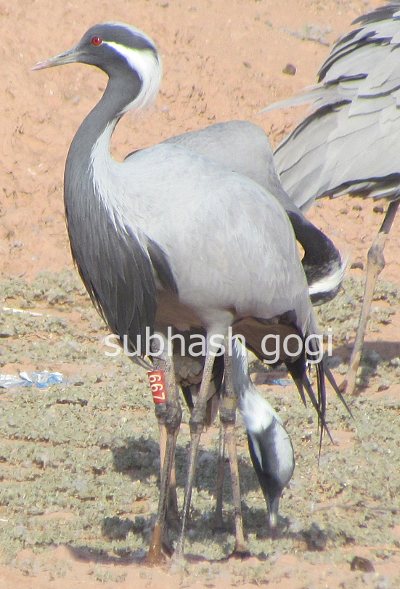 MigrantWatcher Subhash Gogi spotted and photographed a ringed Demoiselle Crane at Khichan village, Jodhpur district, Rajasthan on the afternoon of 6th March 2014. The ring on the bird was red-coloured and bore the number 667.
Further inquiries revealed that the crane was originally ringed in Mongolia on 24th July 2013.
We encourage MigrantWatchers to keep a lookout for ringed birds, as they provide vital information about the fascinating phenomenon of bird migration, which is still poorly understood.
Photo: Subhash Gogi