By Suhel Quader and Uttara Mendiratta from the MigrantWatch team
In 2010 we continued the Pied Cuckoo Campaign, an effort started in 2009 to gather data that would help understand the association between the southwest monsoon and arrival of the migratory population of the Pied Cuckoo to the Indian subcontinent from Africa.
Many people believe that the arrival of the Pied Cuckoo precedes the onset of the monsoon by 1–2 weeks. Is this indeed the case? The Pied Cuckoo campaign was started precisely to answer this question.
Mousumi Dutta, a MigrantWatch participant who works for the Indian Meteorological Department presented an analysis of the 2010 Pied Cuckoo data earlier on this blog; and a year and a half ago, we summarised the findings from the first season of the Campaign.
In this post, we compare the 2009 and 2010 sightings of this species in relation to the onset of the monsoon in these years. (For details of how we filtered and analysed the data, see Details, below.)
The monsoon in 2009 and 2010
The ‘normal’ onset of monsoon on the Kerala coast is 1 June. In 2009, the monsoon arrived 9 days earlier than this; and in 2010, it arrived 1 day earlier than normal. After the onset, cyclones disrupted the normal progress of the monsoon in both years. In 2009, a cyclone in the Bay of Bengal slowed the monsoon’s progress despite an early start across southernmost India, West Bengal, and the northeastern States. In the beginning of June 2010, cyclone ‘Phet’ in the Arabian Sea brought rain to parts of western India, but delayed the northward progress of the southwest monsoon.
Pied Cuckoo sightings in 2009 and 2010
Between 1 May and 15 July, the number of sightings of the Pied Cuckoo reported to the MigrantWatch database was 28 in 2009 and 25 in 2010.
Despite the earlier arrival of the monsoon in 2009 than in 2010, the first sightings of the Pied Cuckoo were on similar dates in both years (17 May and 18 May from Kolkata and Alibag respectively in 2009; and 16 and 17 May from Bhubaneswar and Jalpaiguri respectively in 2010).
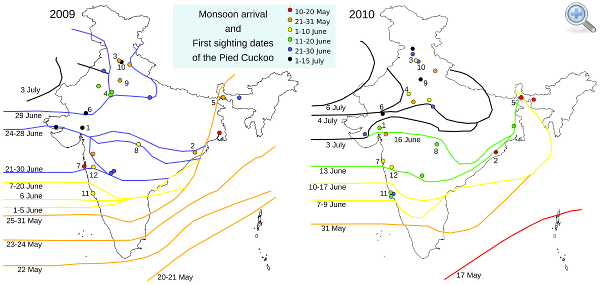
First sightings are shown in relation to monsoon arrival in the maps below. These maps show ‘isolines’ (connecting locations with similar monsoon arrival dates) that depict the approximate advance of the monsoon in the two years (simplified and redrawn from maps issued by the Indian Meteorological Department). The coloured points show the locations and first sighting dates of Pied Cuckoo reports submitted to the MigrantWatch database. Twelve of the points have numbers beside them – these are locations for which first sighting dates are available for both 2009 and 2010. These points are: 1-Ahmedabad, 2-Bhubaneswar, 3-Chandigarh, 4-Jaipur, 5-Jalpaiguri, 6-Mount Abu, 7-Mumbai, 8-Nagpur, 9-New Delhi, 10-Panchkula, 11-Pilerne (Goa), 12-Pune.
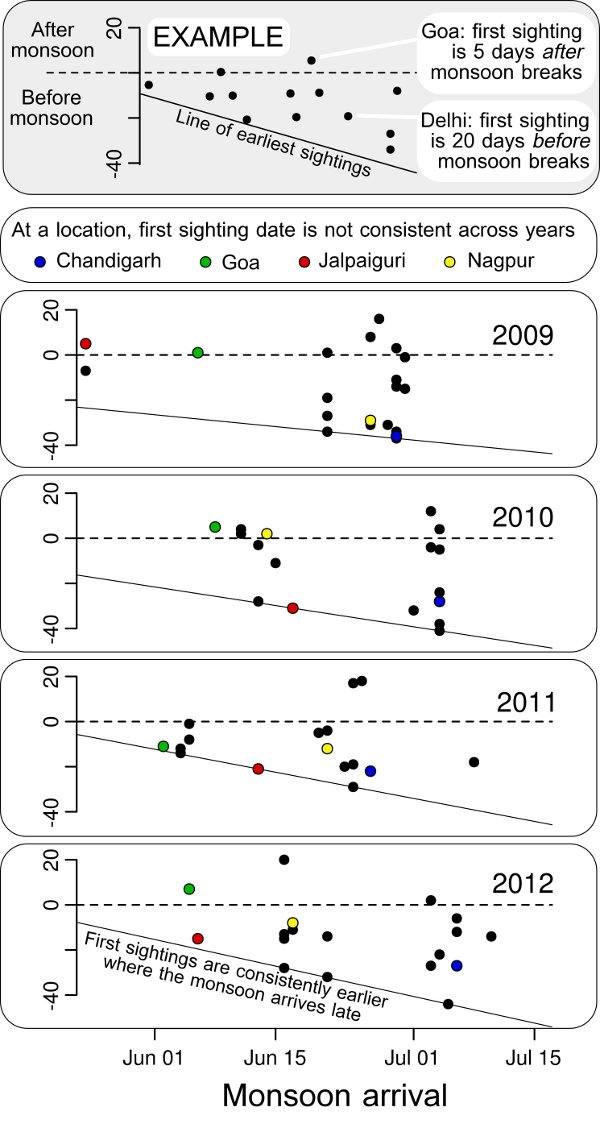
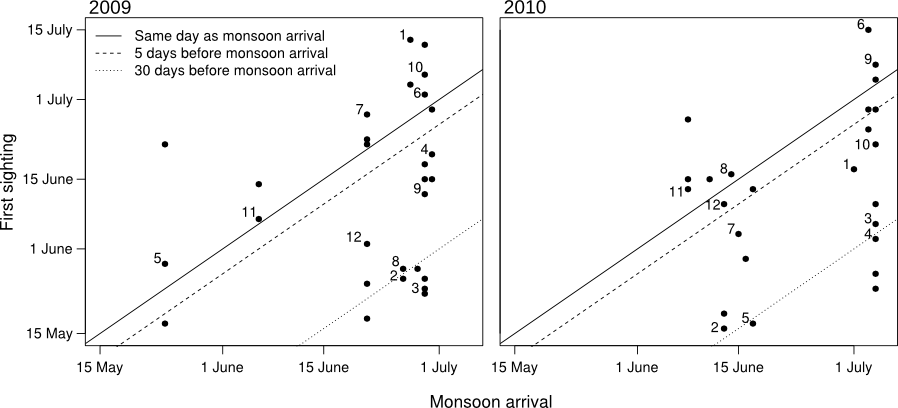
To examine more closely the relationship between monsoon arrival date and Pied Cuckoo sightings, we show a scatterplot of the relationship below. Each point represents a location for which we have both the first sighting date and the approximate monsoon arrival date (taken from the IMD maps). If a point falls on the solid diagonal line it would mean that Pied Cuckoos were sighted on the date of monsoon arrival at that location; if on the dashed line, 5 days before; and if on the dotted line, 30 days before the monsoon arrived. So, if Pied Cuckoos are good at anticipating the monsoon, we would expect the points to march from the lower left to the top right of the plot. If you click on this graph you will see a larger version, on which twelve points are numbered just as in the map above.

|
Details
All records of Pied Cuckoo sightings in the database can be viewed and downloaded here.
The analysis and discussion presented here pertains only to sightings North of 15º N latitude, as sightings from South of this line are likely to belong to the resident population of this species. (All 28 reports of Pied Cuckoos from December to April in 2009/10 and 2010/11 come from the four southern states, and all below 13.4º N latitude.) We’ve also only used sightings from between 1 May and 15 July for both years. And when there were multiple sightings for a location, we used only the earliest sighting for that location.
Caveats and improvements
We don’t pretend that this is a comprehensive analysis, and that these data can conclusively answer the question of whether migrant Pied Cuckoos reliably herald the monsoon. It is possible that first sighting dates reported to MigrantWatch are later than true arrival. In the graphs shown here, we have not distinguished between sightings from contributors who have been frequently monitoring their locations for Pied Cuckoos from those sightings based on first visits at a site. You’ll also notice from the maps that, when selecting first sighting dates, we have simply used the “nearest city” field and shown the earliest sighting for each such city – this is why Chandigarh and Panchkula are shown separately, and why the points representing Pune are in slightly different places in 2009 and 2010. We encourage participants and readers to use the data to carry out and share their own analyses.
Data and Analysis
If you would like to look at the data that were used to produce the visualisations in this post, please download these comma-delimited files (for Graph 1 and Graph 2), which you should be able to open in any spreadsheet software program.
If you wish to check how exactly the data were processed to arrive at the scatterplots above, take a look at these three files: The data downloaded on 30 April 2011 from the MigrantWatch database using a general Pied Cuckoo search; the monsoon arrival dates; and the R script used to process the raw data and generate the scatterplots. For more information on R, see www.r-project.org. After the plots were outputted from R, we made small stylistic improvements in Inkscape. |
The maps and scatterplots suggest that the degree to which the arrival of Pied Cuckoos precedes the monsoon is highly variable. Sometimes the earliest sighting is no more than a few days before the monsoon arrives, and sometimes the earliest sighting precedes the monsoon by more than 30 days. So Pied Cuckoos often do arrive at a location before the monsoon does, but the degree to which they do so varies with location and year.
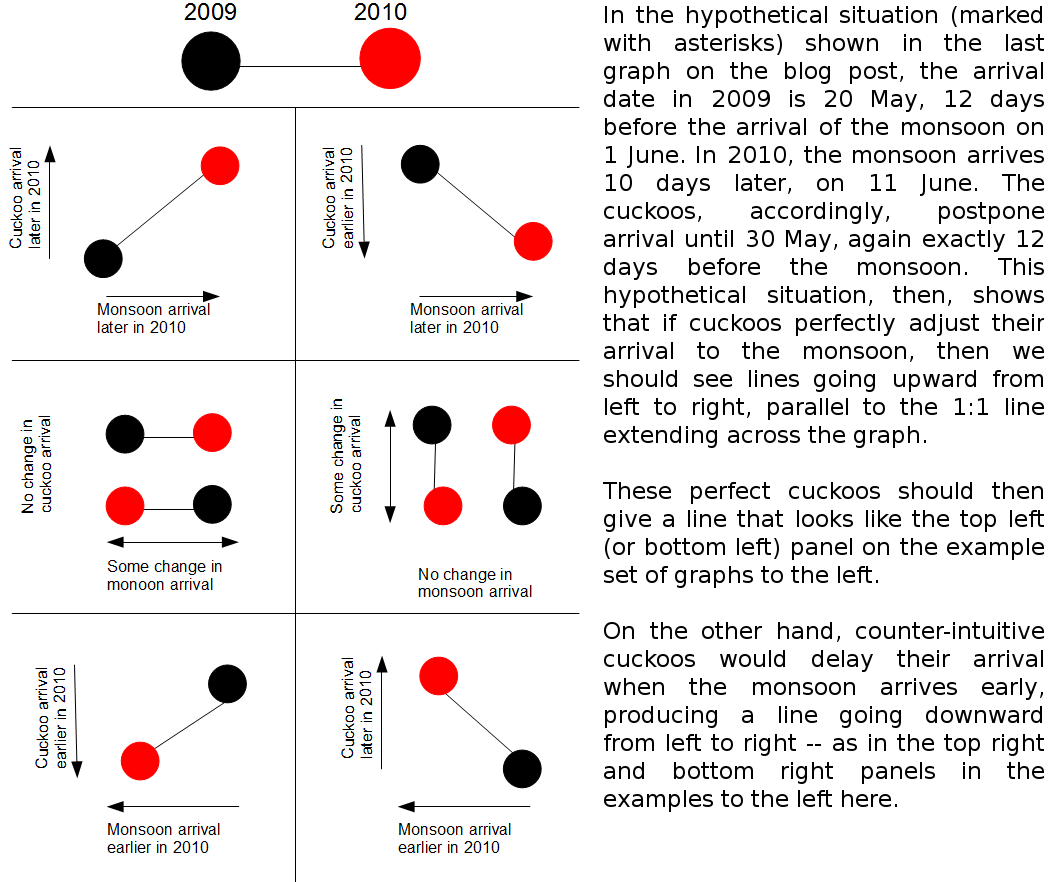
Let’s look at the 12 sites for which we have first sighting dates in both years. The monsoon arrival dates and the first sighting dates from these sites are shown below, with points from 2009 in black and those from 2010 in red. The points for a single location are joined by a line to show how the arrival of the monsoon changed in the two years; and consequently how Pied Cuckoo sighting dates changed. Again, the numbers correspond to the numbered locations on the maps, above.

To help interpret this graph, the two asterisks joined by a dashed line show what one would expect for a hypothetical situation in which the Pied Cuckoos adjusted their arrival perfectly with changes in monsoon arrival — we would see a line pointing upwards from left to right. (For a more comprehensive pictorial and verbal description for how to examine this graph, click here.)
What do we see in the actual data? Out of the 12 locations for which we have information, 6 lines point upward and 6 downward, which means that cuckoos appear to show no consistent differences in arrival date with differences in monsoon onset!
Does this mean we have to revise our dearly-held beliefs about the impeccable timing of Pied Cuckoo migration? Let us know your thoughts in the comments.
Acknowledgements: The most important people in creating this report, as in all of MigrantWatch, are the participants who contributed their time and effort in reporting sightings to the database. This link lists all those whose sightings of Pied Cuckoos between May 2009 and April 2011 were uploaded to MigrantWatch. MO Anand helped in various ways with the preparation of this report. We are grateful for comments from Umesh Srinivasan and R. Jayapal.

 Master cartoonist, keen observer of nature, and wry observer of birdwatchers, Rohan Chakravarty has drawn a cartoon-poem on the meaning of the first monsoon rains.



 flew across our vision and perched on an acacia bush nearby. It was before 6.00 am and the light was quite poor. As we shifted position for a better angle, it flew and I was lucky to get a few rather poor flight shots. No calls were heard. We stayed in the area for another three hours. No further sightings or calls were recorded.